This is the sixth and final (!) part of the review of “Ionic Transport in Nano-Porous Clays with Consideration of Electrostatic Effects” (Tournassat and Steefel (2015) (referred to as TS15 in the following). For background and context, please check the first part.
Recap
Let’s begin by reminding ourselves where we are in the “story” of the article. TS15 begun by vaguely suggesting that diffusion in bentonite1 cannot be modeled by assuming “Fickian” diffusion. The argument, however, is based on the inability of the traditional diffusion-sorption model to be reasonably fitted to ion through-diffusion data. This inability is not primarily due to assuming Fickian diffusion, but due to assuming immobility of the “sorbed” ions and due to assuming that the pore volume contains nothing but bulk water.
After being promised to be presented “fundamental properties” of bentonite that apparently will demonstrate the problem with assuming “Fickian” diffusion, we were instead introduced to a large set of modeling concepts. As a description of actual compacted bentonite, these concepts are mostly irrelevant (e.g. the Gouy-Chapman model), unjustified (e.g. Stern layers on basal surfaces), or simply fantasies (e.g. the idea of “stacks”, or the idea of Donnan equilibrium on the microscopic scale).
Finally, we were presented the Nernst-Planck approach to ion diffusion, which indeed goes beyond a Fickian description. The presented model, however, which includes “bulk water”, “diffuse layer” and “interlayer” domains assumed to be in equilibrium locally, is not suitable for compacted bentonite. Furthermore, no description whatsoever is presented for how this equilibrium is supposed to be maintained. The model is therefore incapable, even principally, to account for swelling — the most profound feature of bentonite in contact with an aqueous solution. Note also that discrimination between “diffuse layer” and “interlayer” domains is based on the pure fantasy of “stacks” as fundamental structural units.
We also showed that the presented Nernst-Planck framework was incorrectly derived, and after having sorted out how it can be reinterpreted,2 we noted that the suggested “concentration” and “diffusion potential” contributions to the diffuse layer flux where completely unfounded.
“From diffusive flux to diffusive transport equations”
In this section I expected to be given an overview of how all the previously introduced model components are supposed to fit together in an overall description for bentonite. With so many parts, there are a large number of quantities to consider. Apart from all the species concentrations in the different “porosity domains”, TS15 have also introduced e.g. electrostatic potentials (eqs. 17, 18, 21, 22, 39, 48, 56 in TS15), adsorption sites on “basal surfaces” (eq. 19 in TS15), “exchanger” sites (eq. 24 in TS15), “layer edge amphoteric” sites (eq. 28 in TS15), models for activity coefficients and their spatial derivatives (eqs. 58, 60, 64 in TS15), and entertained the possibility of having varying sizes of the “porosity domains” (although no constitutive relations has been stated).
Instead, the only thing related to a model description here is a restatement of the mass conservation law. This was already presented in eq. 4 in TS15, but is here incorrectly called the “diffusion equation” (TS15 eq. 65), and stated with an incorrect sign (TS15 eqs. 65, 66 and 68). TS15 express it in its final form as (I have here corrected the sign error, and suppressed an index \(i\))
\begin{equation} \frac{\partial}{\partial t} \left ( \phi_\mathrm{bulk}c_\mathrm{bulk} + \phi_\mathrm{DL}c_\mathrm{DL} + \phi_\mathrm{exch}c_\mathrm{exch} \right) = -\frac{\partial}{\partial x} \left ( j_\mathrm{bulk} + j_\mathrm{DL} + j_\mathrm{exch} \right ) \tag{1} \end{equation}
where \(\phi_\mathrm{bulk}\), \(\phi_\mathrm{DL}\) and \(\phi_\mathrm{exch}\) denotes the bulk water, “diffuse layer” and “interlayer” porosites, respectively; \(c_\mathrm{bulk}\), \(c_\mathrm{DL}\), \(c_\mathrm{exch}\) are the concentrations of the considered species in these “porosity domains”; and \(j_\mathrm{bulk}\), \(j_\mathrm{DL}\), and \(j_\mathrm{exch}\) are the corresponding domain fluxes (presumably given from the previously presented Nernst-Planck framework?).
That’s it.
As the authors stress the importance of adsorption processes throughout the article (even on montmorillonite basal surfaces), I find it very odd to here present an equation that completely omits them. Somewhat ironically, adsorption was included previously, in the section titled “Diffusion basics” (eq. 6 — 8 in TS15). Instead, the above equation (eq. 1) implies mechanisms that may alter the sizes of the “porosity domains” (i.e. \(d\phi/dt \neq 0\), \( d\phi/dx \neq 0 \)). But the article has not presented any constitutive relations for such mechanisms! This whole model presentation feels like having been handed a heap of irregular puzzle pieces with a promise of a grand result, while the reference photo belongs to a different puzzle.
Although eq. 1 provides little concrete information on the actual model, it still manages to contain a fatal flaw: the three domain fluxes are simply added to form some sort of a “total” flux. But this is not how diffusive fluxes work! The first real post I wrote on this blog covered this issue. There we noticed that domain fluxes are added in essentially all publications where multi-porous models are applied to bentonite. To see that separate domain fluxes are not additive should be as simple as considering some specific domain configuration. A trivial example is two domain types connected in series
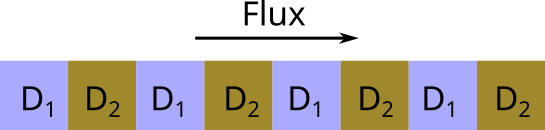
It is easy to see that the resulting flux in this case cannot be described as a sum of independent domain contributions (e.g, the flux vanishes if \(D_1 = 0\), independent on the value of \(D_2\)). More generally, we may instead refer to one of the favorite references on diffusion in the bentonite research field: Crank (1975) has an entire chapter on this topic (“Diffusion in heterogeneous media”).
It really feels silly to point out, but the knowledge that domain diffusivites generally don’t add was established long before any numerical reactive transport tools were developed. I have trouble expressing what an incredible own goal this procedure is: even if it made sense to partition compacted bentonite into various “porosity domains”, using eq. 1 will still lead to incorrect inferences.
“Applications”
Rather than providing the reader with an actual model overview, TS15 proceed with presenting three different cases, which were modeled with either “CrunchFlowMC” or “PHREEQC”. These case studies are motivated with that they
[…] are used to illustrate the importance of considering coupled diffusion/surface reaction effects in order to understand and to predict migration processes and associated parameters in charged porous media, especially clays.
Let’s keep this formulation in mind as we go through the cases. (Spoiler: we will not be illustrated the importance of much, nor will we be able to understand or predict anything.)
The three tests that have been modeled are:
- Tachi and Yotsuji (2014)
This is a diffusion and “sorption” study of cesium, sodium and iodide in pure Na-montmorillonite. Tracer through-diffusion has been performed for each of these ions in samples of 0.8 g/cm3, at three different background concentrations (NaCl): 0.01 M, 0.1 M, and 0.5 M.
- Glaus et al. (2013)
This is the “uphill” diffusion study. It presents the result of two through diffusion tests in pure Na-montmorillonite (1.9 g/cm3), where a Na tracer is observed to migrate from a 0.1 M NaClO4 reservoir to a 0.5 M NaClO4 reservoir, although the tracer concentration in the 0.1 M reservoir is lower than in the 0.5 M reservoir.
- Tertre et al. (2015)
This paper presents the results of performing Ca-to-Na ion exchange on initially pure Ca-vermiculite (1.8 g/cm3). Disc-shaped single crystal vermiculite samples were immersed in initially pure NaCl solutions, and the evolution of calcium concentration in these solutions was monitored. The samples were prepared in such a way that out-diffusion only occurred at the outer edge of the vermiculite discs. Tertre et al. (2015) present four such tests, performed with NaCl concentrations 0.003 M, 0.05 M, 0.1 M, and 1.0 M. In addition, three tests were performed with NaCl concentration 0.05 M, which were terminated after 1.94, 7.01, and 18.06 days, respectively. Subsequently, the radial distribution of calcium was measured in these samples, giving “snapshots” of the internal Ca profile.
A common theme of these studies is that they primarily demonstrate effects of exchangeable cations being mobile. Tachi and Yotsuji (2014) clearly show the commonly observed effect of cation “effective diffusivity” becoming increasingly large as the background concentration is lowered, which has been unambiguously demonstrated to be an effect of “interlayer diffusion being the dominant pathway”. Glaus et al. (2013) is a proof-of-concept demonstration of a consequence of the exchangeable cations dominating mass transfer, as I discussed in some detail here. Tertre et al. (2015) assert from the start that “For this type of model system, the interlayer region is the only pore space that contributes to the overall diffusion process […]”.
With this background information, we will go through how TS15 handle and present these modeling cases. We will do this with focus on what I think are some reasonable requirements on a modeling exercise, especially in a review article that is supposed be a “fully developed text which can be used for self-study, research, or as a text-book for graduate-level courses.” According to me, a modeling task should include
- A clear statement of the exact model used
- Some sort of quality analysis of the data being modeled, e.g. a separation of signal and noise. It should also be motivated why certain data is modeled while other is not.
- A summary that relates the model results to actual physical processes, and discusses possible implications.
Tachi and Yotsuji (2014)
Without commenting on it, TS15 only model results obtained at background concentration 0.1 M and only in samples of length 10 mm. A reason for this may be that Tachi and Yotsuji (2014) only present reservoir concentration evolutions and final state concentration profiles for all ions at these conditions. However, TS15 anyway disregard the final state profiles and only compare their model with the concentration evolutions. Furthermore, for cesium, the original article contains plots also for background concentrations 0.01 M and 0.5 M. Tachi and Yotsuji (2014) actually present fitted model parameters for all tests. If TS15 were serious about exploring this type of diffusion they could consequently have made a systematic comparison rather than just fitting a model to some rather arbitrarily chosen test results. This is particularly remarkable, as the most prominent feature of tests like this — that the “effective diffusion coefficient” for cations increases essentially without bound with decreasing background concentration, while the same quantity for anions approaches zero — is not really explored, when they only model results from a single background concentration.
It is also clear that TS15 show no interest in the quality of the data. Looking at Tachi and Yotsuji (2014) in a bit more detail, the data has some flaws and inconsistencies. For example, for all background concentrations, Tachi and Yotsuji (2014) report two quite different values of the “anion accessible porosity”,3 depending on whether the sample is 5 or 10 mm long. (TS15 “conveniently” choose the value 0.421 and ignore the value 0.635.) A further inspection also indicates that filter restriction has influenced some of the data, although they have attempted to eliminate such artifacts.4
TS15 don’t clearly state what model components they include, and it is essentially impossible to figure out the exact model used for this exercise. Half way through the section, the model is referred to as the “bulk + diffuse layer water diffusion model”, so it is quite safe to state that they have only included a bulk water and a “diffuse layer” domain. As the description in TS15 is fundamentally based on the (flawed) idea that we can distinguish between “external” and “internal” surfaces in compacted bentonite, it is quite remarkable that the “interlayer” domain is here completely left out. To me, this suggests that TS15 are not themselves especially serious about differing between “diffuse layers” and “interlayers” (after all, this difference is a fantasy, as I have argued throughout the review). This sloppy approach to modeling is, in my opinion, a recipe for ending up with an overparameterized mess. It is also worth noting that TS15 simply fix the size of the the bulk water domain by requiring the model to be “in close agreement” with measured “anion accessible porosity”.5 Thus, after 34 pages of text containing a myriad of mathematical expressions and a specific “consideration of electrostatic effects,” we ultimately just end up with knob-twiddling.
Speaking of electrostatic effects, TS15 don’t comment how aspects of multi-component diffusion influence the results. It is not even clear that the Nernst-Planck framework has been used in this particular modeling. For example, only a single set of fitted tracer diffusion coefficients are reported6 (and no transport parameters are reported for the main electrolyte). Are these supposed to relate to the bulk or the “diffuse layer” domain? I find this lack of discussion quite remarkable, given the emphasis in the rest of the article on the idea that ion diffusion in bentonite is supposed to be fundamentally “non-Fickian”.
TS15 do not even manage to clearly communicate the principal reason as for why the model “makes it possible to calculate the diffusive flux of neutral species, anions and cations with the same conceptual model and with physically feasible parameters.”7 This reason is — of course — that the model allows for exchangeable ions to move and that it provides a mechanism (Donnan equilibrium) for altering the relative ion concentrations in the “diffuse layer” domain. In fact, a more reasonable analysis demonstrates that tracer through-diffusion in bentonite can be satisfactory modeled using a single homogeneous domain for the clay. A homogeneous description is also compatible with basically all other experimental findings in compacted bentonite, as we have discussed massively on the blog.
In contrast, TS15 assume, not only that the montmorillonite in this particular test contains 50% bulk water, but also the existence of a Stern Layer — with corresponding ion immobilization — on montmorillonite basal surfaces. As neither of these assumptions are justified or reasonable, it is clear that the resulting model is overparameterized. Any successful fit thus provides little real information or insight, which also becomes almost comically clear when it is concluded
Results are plotted in Figure 19. The tortuosity values follow the order \(\tau_\mathrm{I^-} < \tau_\mathrm{HTO} < \tau_\mathrm{Na^+} < \tau_\mathrm{Cs^+}\), indicating that the tortuous diffusion pathways are not the same for all of these species. Or alternatively, that the adsorbed species in the Stern layer, considered in the calculations as immobile, are in fact mobile.
The result of the modeling exercise indicates either one thing, or a completely different thing!
Note that TS15 here put forward the bizarre notion that each separate species diffuse in different pore structures, with different “tortuosities”. They apparently don’t dismiss the untenable idea that cesium (with fitted “tortuosity” 0.136) for some reason diffuses though a much less meandering pore network than water (with “tortuosity” 0.047). In reality, the much larger “tortuosity” (which here means a less tortuous network…) for cesium as compared with water indicates that the model underestimates the amount of mobile cesium in the “diffuse layer” and compensates for this by giving it a too large diffusivity. This is signature behavior of an overparameterized model.
How this treatment and way of reasoning is supposed to “illustrate the importance of considering coupled diffusion/surface reaction effects” should be a mystery to any reasonable reader.
Glaus et al. (2013)
Things get even worse, in my opinion, as TS15 next present a modeling of the “uphill” test. Providing a solid explanation for this test could have been a major contribution to the article, as it earlier has claimed that the “uphill” effect is an example of “non-Fickian diffusion processes” and has implied that the effect is caused by non-trival electrostatic couplings. But TS15 seem genuinely uninterested in analyzing how the “uphill” effect arises in their model. Again, the adopted model is not presented in full, and focus is mainly on irrelevant details, such as filter diffusivity.8 The only attempt at describing a mechanism for “uphill” diffusion is half a sentence that says
[…] the macroscopic driving force of the diffusion is the diffusion potential in the diffuse layer, as shown in Figure 12.
But “Figure 12” shows results of “example 3”, from the section on the Nernst-Planck framework (discussed here), rather than results from the actual “uphill” test modeling. The burden of connecting “Figure 12” with the actual “uphill” test is completely left to the reader. I find this very peculiar for several reasons. To begin with, as TS15 evidently have modeled the actual “uphill” test, why don’t they refer to and show the “diffusion potential in the diffuse layer” in the actual model? And although “Figure 12” shows an “uphill” cation flux, the Nernst-Planck transport equations are not solved in “example 3”; in these examples, flux contributions are calculated from imposed linear concentration profiles in a bulk water domain. But since the “uphill” test here has been modeled with a tool that apparently solves the Nernst-Planck transport equations, I find it incomprehensible that these results are not reported. It is also worth noting that TS15 don’t compare their model with the final-state concentration profiles, even though these are readily available in the original publication.
The earlier examples, moreover, assume a density of approximately 1.0 g/cm3 (porosity 0.64), and a bulk water domain that dominates the pore volume. The “uphill” test, in contrast, was conducted at nominal density 1.9 g/cm3 (porosity \(\sim\) 0.3). TS15 themselves explicitly comment that “[a]t this high degree of compaction, the actual presence of bulk water is not certain”.9 Other conditions also differ strongly between these systems. The “uphill” test was performed with NaClO4 as main electrolyte, while “example 3” uses NaCl. “Example 3” has boundary concentrations 0.1 M and 0.001 M for the main electrolyte, while the actual “uphill” test, in contrast, has 0.5 M and 0.1 M.
Disregarding these glaring differences between the actual “uphill” test and “example 3”, the explanation given by TS15 in the above quotation is that the cation tracer ions move “uphill” due to “the diffusion potential in the diffuse layer”. In an earlier part of this review we demonstrated that the way TS15 define the “diffusion potential” contribution to the flux is obvious nonsense, based on misunderstanding the electric potential. To remind ourselves, in “example 3” TS15 make the absurd claim that a tracer concentration profile in the “diffuse layer” that looks like this (this is part of “Figure 12”)

makes NO “concentration gradient” contribution to the flux (because TS15 define such contributions exclusively in terms of bulk water concentrations). Instead, the diffuse layer cation tracer flux in “example 3” is supposed to be driven by an electric field (the “diffusion potential” contribution) in the wrong direction.
We have shown that these preposterous definitions of flux contributions can be corrected, with the correction term involving the gradient of the Donnan potential.10 With reasonable flux definitions, we demonstrated that the “uphill” flux in “example 3” is essentially completely governed by the contribution from the “diffuse layer” concentration gradient (i.e. that the cation tracer flux is “Fickian”). Recently on the blog, we have also calculated the electrostatic potential within the homogeneous mixture model and specifically demonstrated that effects of electromigration on the tracer flux is negligible in the “uphill” test.
Making a way too generous interpretation of the above statement, it may perhaps be claimed to be “true” if we accept that “the diffusion potential” refers to the absurd definition given in TS15, rather than to an actual electric field. It is, however, clear that TS15 completely fail to clarify that the “uphill” effect is caused by exactly the same mechanism as is active in conventional cation tracer through-diffusion in bentonite. Even worse, the way the “uphill” effect is discussed here may fool a reader to believe that it has other causes.
Rather than identifying any of the above points, TS15 instead spend a large part of this section discussing that several models, which “are totally different from a conceptual view”, can be fitted to the “uphill” diffusion test data. But all models that can be fitted to the “uphill” test data have this ability because they (i) assume mobility of exchangeable ions and (ii) provide a mechanism for ion equilibrium with bulk water. From the point of view of fitting the data, it is secondary if a model treats the ion equilibrium via “exchange sorption” or Donnan equilibrium,11 or if the compartment containing the exchangeable ions is referred to as “interlayer”, “diffuse layer” or interlayer. That TS15 choose to emphasize that their model fits “equally good”, while it contains several additional and unjustified assumptions, simply indicates that they don’t consider the dangers with overparameterization.
The presentation of the modeling of the “uphill” test in TS15 does not “illustrate the importance of considering coupled diffusion/surface reaction effects in order to understand and to predict migration processes…”. Rather, it obscures process understanding.
Update (261006): The “uphill” test is modeled with the Nernst-Planck framework and the homogeneous mixture model here.
Tertre et al. (2015)
As with the previous cases, the description of the modeling of Tertre et al. (2015) lacks sufficient detail, preventing the reader from determining exactly which model was used. Actually, the only model information given is that the data was “reinterpreted using the interlayer diffusion option of PHREEQC”. This must obviously mean that an “interlayer” domain is included in the model, in contrast to the previous cases. But are other domains included? (we have previously been informed, in passing, that “PHREEQC” requires a bulk water domain).
Furthermore, it is not clear if a Stern layer is included in this model, i.e. if some of the exchangeable ions are assumed immobilized, as in the previous cases. As not a word is spoken about this, we reasonably must assume that no Stern layer is included. If this is the case, the inclusion of an immobilization mechanism when modeling Tachi and Yotsuji (2014) and Glaus et al. (2013) becomes even more conspicuous. In fact, TS15 state about Tertre et al. (2015)
This experiment showed unambiguously that interlayer diffusion exists and it made it possible also to quantify the diffusion coefficient for \(Ca^{2+}\) in the interlayer.
I find this statement remarkable for a couple of reasons. As TS15 don’t say anything similar when discussing the other studies, I here get the impression that they haven’t comprehended that “interlayer diffusion” has been unambiguously demonstrated much earlier than in Tertre et al. (2015). Also, if TS15 now acknowledge that interlayer diffusion “exists” in bi-hydrated vermiculite, how come that they don’t assume this to be the primary mode of transport in the other models, but instead add an immobilization mechanism? Are ions supposed to become less mobile in less dense systems with lower layer charge density? We should also remember that earlier in the article, TS15 describe the “interlayer” as pure Stern layers. So, how is it, are Stern/interlayer ions supposed to be mobile or not? Again, I think this relaxed attitude towards when and how various domains are included, and how they are treated, demonstrates that TS15 themselves don’t take the concepts of “diffuse layer” and “interlayer” seriously.12
Furthermore, the “reinterpretation” of this experiment is entirely untenable. Tertre et al. (2015) put a lot of effort in demonstrating (using “Brownian dynamics simulations”) that the observed diffusion is strongly influenced by processes occurring at the interface between the sample and the external solution. This makes sense, as we may expect huge concentration gradients within the clay when two different cations are involved. Such gradients are difficult to maintain, and the resulting flux can instead be expected to be controlled by interface transfer resistance. This is similar to how filters limit the flux in cation through-diffusion tests at low ionic strength. In the “reinterpretation”, TS15 completely neglect any possible interface transfer resistance, claiming
It was possible to reproduce the data with the same level of quality as the Brownian dynamics calculations by considering an interlayer \(Ca^{2+}\) diffusion coefficient value of \(0.8\times 10^{-11}\) \(\mathrm{m}^2\cdot \mathrm{s}^{-1}\), together with an interlayer \(Na^{+}\) diffusion coefficient of \(4\times 10^{-11}\) \(\mathrm{m}^2\cdot \mathrm{s}^{-1}\), \(1\times 10^{-11}\) \(\mathrm{m}^2\cdot \mathrm{s}^{-1}\), \(0.1\times 10^{-11}\) \(\mathrm{m}^2\cdot \mathrm{s}^{-1}\), and \(0.1\times 10^{-11}\) \(\mathrm{m}^2\cdot \mathrm{s}^{-1}\), for the experiments at NaCl concentration of 1, 0.1, 0.05 and 0.003 \(\mathrm{mol}\cdot \mathrm{L}^{-1}\) respectively. The decrease of the \(Na^{+}\) interlayer diffusion coefficient with NaCl concentration is in agreement with MD results from Tertre et al. (2015), which show a decrease of its value with an increase of the \(Ca^{2+}\)/\(Na^{+}\) occupancy ratio in the interlayer (Fig. 21c).
The last sentence is false. Tertre et al. (2015) indeed report a decrease of the sodium self-diffusion coefficient, but this decrease is lower than a factor 3.13 In the model of TS15, in contrast, this decrease is a factor 40 (!), which certainly cannot be considered “in agreement”. In addition, experimentally, Kozaki et al.(2005) observed no systematic decrease of Na diffusivity with increasing Ca fraction, in bi-hydrated montmorillonite; if anything, they observe a slight decrease (25 — 60%) of Na diffusivity only in pure Ca-montmorillonite. TS15 anyway goes so far as to conclude this part by stating
Consequently, the apparent decrease in \(Ca^{2+}\) interlayer diffusion coefficient can also be interpreted as a result of the decrease of the \(Na^{+}\) interlayer diffusion coefficient that arises from the coupling between the diffusion of these two species through the diffusion potential term in Equation (57).
Let’s unpack the serious error of reasoning on display here: rather than taking into account interface transfer resistance — a process that we have every reason to believe is active, and that is expected to produce the observed behavior — the observed behavior is supposed to be caused by an unjustified 40-fold decrease of the sodium self-diffusivity, as the external concentration decreases. A mobility decrease that do not even correlate directly with the calcium content of the clay! Note also that TS15 state that the decrease in sodium diffusivity is caused by electromigration (“the diffusion potential term in Equation (57)”). But, as far as I understand, these sodium diffusivities were just put in by hand! (See previous quotation.) It is completely unreasonable that TS15 are here allowed to provide this “explanation” without showing a single result from the actual modeling of how this “diffusion potential term” is supposed to change under different conditions.14
It feels silly to point out that this modeling does not in any way “illustrate the importance of considering coupled diffusion/surface reaction effects in order to understand and to predict migration processes…”. Instead, it is a horrific example of “modeling” as a game, where the only aim is to be able to fit a model to some arbitrary data.
The overall impression of these modeling cases is that TS15 do not seem interested in understanding or communicating how compacted bentonite really works: models are not fully described, and components seem included or disregarded pretty much on a whim; no attention is paid to the quality of the data that is modeled, nor to how data is chosen; and discussions are completely absent regarding how the modeling can aid process understanding. I also find it curious how little these modeling cases connect with the main topics discussed in the rest of the article. For example, very little is said about the impact of multi-component diffusion, even though “non-Fickian” diffusion is a a major theme of the article (it is often not even clear when and how multi-component diffusion has been implemented). Likewise, although sorption processes are included in some of the model cases, we are not told anything about their significance. And not a word is spoken about evolving volumes of the various “porosity domains”, even though such processes seem to be taken seriously in other parts of the article.
“Summary and perspective”
We have finally arrived at the last page of the article. The first paragraph of this section mainly concerns the shortcomings of the traditional diffusion-sorption model (“the classical Fickian diffusion model”)
In this context, the classical Fickian diffusion model applied in the framework of a single pore diffusion model with linear adsorption processes (\(K_D\) model) appears to be inappropriate for describing diffusion data without making less than satisfying modeling assumptions, such as i) different definitions of the porosity as a function of the nature of the tracer of interest (see anion accessible porosity) and as a function of the conditions (anion accessible porosity change with time; ii) change of the adsorption parameters from batch to diffusion experiment; and iii) physically unrealistic pore diffusion coefficients (or tortuosity values).
I agree with that the traditional diffusion-sorption model is not suitable for bentonite. But this has been known for a long time, as I have argued from the beginning of this review. That TS15 use this model as a starting point — and argues for modifying it rather than dismissing it — is in my head a recipe for disaster.
I want to emphasize that all empirical evidence points to that compacted water saturated bentonite is a “single pore” material. The main problem with the traditional diffusion-sorption model is not that it assumes a “single pore”, but that this “single pore” is assumed to contain bulk water. Letting go of the bulk water allows for a satisfying bentonite model using a single pore type. I’ve elaborated on these points here and here.
This first paragraph also says
Diffusion processes through clay materials is the result of a complex interplay of transport and non-linear adsorption processes under the influence of electrostatic fields.
This formulation must be interpreted as summarizing what has been covered in the article as a whole. But I don’t agree with this description, and throughout this review we have exposed flaws and shortcomings in much of the presented material. Of course, ion diffusion is generally influenced by electric fields, since the diffusing entities carry charge. But we have shown that the definition of a “diffusion potential” made by TS15 makes no sense and is based on misunderstanding how electric potentials function. With corrected definitions we have further shown that processes described by TS15 as being due to a “diffusion potential” is actually mainly driven by concentration gradients, i.e. the diffusion processes are “Fickian”. I see it as a major problem that many researchers don’t recognize diffusion in compacted bentonite as simpler than usually described.
This sentence also claims that “non-linear adsorption processes” are involved generally in ion diffusion in bentonite. But this is not the case! The ions that the article mostly focuses on — e.g. sodium, calcium, chloride and iodide — don’t show any signs of adsorption15 at all, let alone “non-linear” adsorption.
The second paragraph of this section is fully devoted to “non-linearity of adsorption processes for strongly adsorbed species”, with particular focus on cesium. I find this peculiar, as non-linear sorption is only brought up in a single small part in the article, and as nothing is said about non-linearity in the the reported “application” that involves cesium (Tachi and Yotsuji, 2014)
The third paragraph begins
Recent developments of selected RT [reactive transport] codes that can handle diffusion processes in diffuse layer and interlayer porosities made it possible to model the diffusion data of neutral, anionic and cationic species within the same conceptual framework.
Here is presumed that partitioning of the pore space into “diffuse layer” and “interlayer” domains makes sense. But we have thoroughly discussed that this whole notion — which is based on the fantasy concept of “stacks” as fundamental structural units of compacted bentonite — makes essentially no sense. And, as we noted earlier, TS15 themselves employ these “porosity domains” for convenience, rather than from being constrained by empirical evidence.
Moreover, it is not the ability to define both “diffuse layer” and “interlayer” that makes it possible to treat any type of species “within the same conceptual framework”16 Rather, a coherent model for compacted bentonite is made possible by realizing that exchangeable ions are mobile and by treating the corresponding ion equilibrium when required. This is (and has been) most adequately made in a homogeneous model.
The third paragraph continues
Also, the contribution of the diffuse layer and/or the interlayer to the overall diffusion of ions makes it possible to explain the origin of the apparent acceleration of cation diffusion as compared to water, which otherwise would require unrealistic tortuosity values for cations in classical Fickian diffusion models.
It is not true generally that cation diffusion is “accelerated”. Speaking of “accelerated” cation fluxes is mostly relevant for steady-state in conventional through-diffusion tests at low background concentration. Writing like this makes me suspect that TS15 have not identified this distinction, especially since they do not recognize the importance of interface equilibrium. As I discussed in the first part of the review, e.g. sodium and chloride show almost identical diffusive behavior in bentonite. The additional effects observed in through-diffusion is completely due to Donnan equilibrium at the interfaces to the external solutions, as has been explained in detail long before the publication of the present article. Again, TS15 contrast with “classical Fickian diffusion models” — but it has been fully clear from the start that the traditional diffusion-sorption model does not apply to compacted bentonite. The way TS15 here use the phrasing “diffuse layer and/or interlayer” again indicates that they don’t take their own concepts seriously. The third paragraph ends
RT modeling has also helped to improve our understanding of anomalous diffusion behavior such as that of up-hill diffusion.
This is a horrible statement. That they refer to the “uphill” effect as “anomalous” tells me that they have neither understood this experiment, nor how bentonite works.17 And if they by “RT modeling” mean the previously presented modeling of the “uphill” effect, nothing can be further from the truth than claiming that it has improved understanding. I also find it significant that they don’t connect the “uphill” test to the previous statements in the same paragraph; the “uphill” test was designed to demonstrate that cation diffusion is not simply “accelerated” (it is, in a sense, conventional tracer through-diffusion that is “anomalous”).
The fourth paragraph reads
Despite the successes of these new RT modeling approaches, it must be stressed that the model and its parameters derived from diffusion experiments are not always unique. Two examples given above highlight the fact that several different conceptual models can provide equally good fits of the data. As such, the modeling effort is typically under constrained, a fact that explains the multitude of conceptual and numerical models available in the literature that describe the ionic transport properties of clay media (Leroy et al. 2006; Appelo and Wersin 2007; Gonçalvès et al. 2007; Birgersson and Karnland 2009; Gimmi and Kosakowski 2011; Tachi et al. 2014).
I strongly disagree with this whole line of reasoning. The multitude of models is not explained by them being “under constrained”; it is explained by most of them being overparameterized (which is poison).
Serious modeling work requires that all included components be evaluated and justified on physical grounds. I see very little of this in the contemporary bentonite scientific literature. We can use the “uphill” test modeling to illustrate this point. The model of this test in TS15 includes, among other things, a mechanism for sodium adsorption and immobilization on basal surfaces (a Stern layer). The test, however, has already been demonstrated to be well described by models that don’t include such a mechanism. This test can therefore not in itself be used to motivate the inclusion of a Stern layer. On the contrary, if there are no other reasonable arguments for why sodium is supposed to adsorb and become immobilized in montmorillonite, it is bad modeling practice to include a Stern layer component.
To make an absurd analogy: if I, as a modeler, don’t have to motivate the included components, I may claim that bentonite contains invisible unicorns that eat anions (or whatever), as long as my model can be fitted to some arbitrary data. This may sound funny, but at least in my head, contemporary bentonite models are quite full of “unicorns”, e.g.
- They include significant amounts of bulk water
- They rely on the fantasy concept of stacks
- Equilibrium between various domains is maintained without a mechanism
- They postulate regions completely devoid of anions
- Diffusive fluxes from various domains are added
- Simple ions, e.g. sodium, are assumed to bond covalently (or whatever) to montmorillonite basal surfaces
In the last paragraphs of this section, TS15 argue for that more research is needed to overcome the claimed problem of models being “under constrained”, using e.g. molecular dynamics simulations and developing new observation techniques. In contrast, I firmly believe that for modeling activities to be meaningful, researchers instead need to spend much more effort scrutinizing and analyzing their models — and the data they are fitting them to. This is much of what I’m trying to do on this blog.
Final comments
My main interest in doing this review has not been in the specific article that we have dissected, but in how it reflects the state of a broader part of the bentonite research field. After finishing, my initial opinion is strengthen: this research field is in a terrible state. I am now fully convinced that reasonable support is nowhere to be found for several of the concepts frequently adopted in contemporary bentonite descriptions. This applies in particular to the ideas of “stacks” as fundamental structural units, the presence of bulk water within the bentonite, and a general adsorption/immobilization mechanism for ions on montmorillonite basal surfaces (Stern layer). To me, it is also clear that this research field lacks knowledge of how salt exclusion and swelling actually work in compacted bentonite, as well as insight into how central these phenomena are for an adequate description.
In today’s bentonite scientific literature, you can simply close your eyes and point at random to find articles that peddle much of the type of nonsense listed above. An illustrative (literally!) example of this legacy is found in Chen et al. (2024)
In the past decades, scholars have carried out a lot of research on the pore structure of compacted bentonite, and it is now generally accepted that there are three different types of pores, including inter-aggregate pores, inter-particle pores and interlayer (or inter-laminar) pores (Lloret and Villar, 2007; Wang et al., 2014), as shown in Fig. 1.
[…]
In existing research, water existing inter-aggregate pores, interparticle pores and interlayer pores are usually referred to as free water, double layer water and interlayer water. In general, anions only diffuse in free water because anions are expelled from the interlayer water and double layer water owing to exclusion effect (Glaus et al., 2007; Wu et al., 2020). Adversely [sic] cation diffusion is supposed to occur in all three types of water due to positive adsorption, corresponding to free water diffusion, surface diffusion and interlayer diffusion, respectively (Melkior et al., 2009; Tachi and Yotsuji, 2014; Yang and Wang, 2019)
“Fig. 1” in Chen et al. (2024) looks very similar to this18
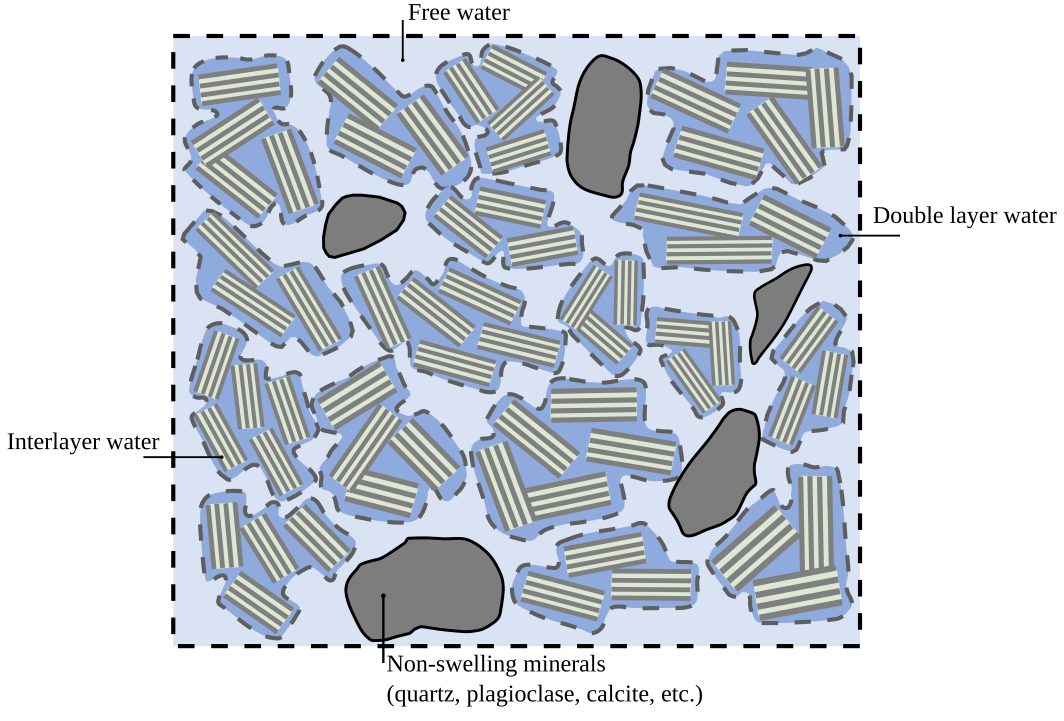
The saddest aspect of this quotation is that it is partly correct: “Scholars have carried out a lot of research” for “decades”, and this view is “generally accepted”.
I cannot say that doing this review has answered my question as to why this is the state of the bentonite research field, but maybe a hint is given by the attitude expressed in TS15 towards modeling and model development. I believe this field will have trouble progressing as long as “modeling” is synonymous with getting arbitrary mathematical descriptions to fit arbitrarily chosen data, padded with empty talk.
Footnotes
[1] As I have commented in the earlier parts: TS15 are fond of using the general terms “clays” and “clay minerals”, while it is clear that the publication mainly focus on systems with substantial ion exchange capacity and swelling properties. Here we will continue to use the term “bentonite” for these systems, and ignore the frequent references in TS15 to more general terms.
[2] Such reinterpretation involves the gradient of the bulk water electrical potential — a potential that TS15 put strictly equal to zero. It also involves the gradient of the Donnan potential — a potential that TS15 mistake for the electric potential in the diffuse layer, when it actually describes the potential difference between bulk and diffuse layer.
[3] Tachi and Yotsuji (2014) report “rock capacity factors” for iodide, which erroneously often are interpreted as anion-accessible porosities. TS15, as we have seen, go “all in” on this concept, while simultaneously admitting that it is fictitious. (?!)
[4] We have noted earlier that it seems very difficult to completely eliminate the effects of interface transfer resistance.
[5] Note that the “correct” value is the arbitrarily selected experimental result 0.42, while the other experimental result of 0.64 is ignored. Also remember that the way this parameter varies with ionic strength is not at all explored by TS15, as they only model results from tests with 0.1 M background concentration.
[6] TS15 report “tortuosities”, rather than actual diffusion coefficients. In a bentonite context, the only way such quantities make sense is as a measure of the diffusion coefficients in terms the corresponding bulk water value, as we discuss here.
[7] I object to that the model parameters are “feasible”. It is in my head a completely ludicrous idea that half the pore volume in pure sodium montmorillonite at 0.8 g/cm3 should contain bulk water — the swelling pressure for a 0.1 M NaCl background concentration is expected to be above 0.4 MPa! Also, the idea that the diffusivity of cesium in montmorillonite is much larger than for sodium, iodide or water is completely unreasonable. In fact, TS15 state that “feasible” simply means a cesium diffusivity that is smaller than for pure bulk water. This shows that they are under the impression that “\(D_e\)”, rather than “\(D_a\)”, quantifies the actual diffusivity in the clay. For a further discussion on this, see here.
[8] Including filter diffusivity in this modeling is certainly not irrelevant per se. However, TS15 merely assign a seemingly random value to this quantity and do nothing more about it. All subsequent inferences are thus contingent on this particular value, yet the authors have neither demonstrated if nor how it influences the overall process.
[9] Although I agree with that these systems don’t contain any appreciable amount of bulk water, we note that no reference is given for this claim. I find this annoying, as TS15 simultaneously don’t hesitate to ascribe 50% bulk water to pure Na-montmorillonite at 0.8 g/cm3. As commented earlier, such a system is expected to have swelling pressure above 0.4 MPa.
[10] We still found serious problems with the model formulation, as further discussed in part 5 of the review.
[11] Also remember that ion exchange is Donnan equilibration!
[12] As always, we should also remember that the distinction betweeen “diffuse layers” and “interlayers” (with quotation marks), or similarly, between “inner” and “outer” basal surfaces, is pure fantasy.
[13] It’s not completely straightforward to extract exact MD values from Tertre et al. (2015). But, discussing them in terms of “surface mobility”, they write: “the mobility for Na is variable from approximately 0.04 to approximately 0.015 when the equivalent fraction of Ca in the solid increases from 0 to 1.” This is a decrease by a factor 2.7.
[14] Note, for instance, that sodium is set to be faster than calcium for the cases of 1.0 M and 0.1 M NaCl, while it is set to be slower than calcium for the cases of 0.05 M and 0.003 M NaCl. Is calcium supposed to be able to retard the sodium flux to such an extent that the sodium ion in the end diffuses slower than the calcium ion?! Note also that the sodium mobility in the TS15 model is lowered by an order of magnitude as the external concentration is only lowered from 0.1 M to 0.05 M! (Or, if the corresponding figure rather than the text is correct, the mobility is even lowered by a factor 40 (the later sections of the paper contain an unacceptable amount of typos of this kind).)
[15] Of course, if ion exchange is supposed to be an “adsorption” process, any cation do “adsorb”. But using such a label for a process that actually may enhance the diffusive flux is, in my opinion, a very bad idea.
[16] To me, the “conceptual framework” promoted in TS15 is “add stuff as you please (but keep bulk water at all costs)”.
[17] Calling the “uphill” effect “anomalous” also seems to contradict the previous general statement that “Diffusion processes through clay materials is the result of a complex interplay of transport and non-linear adsorption processes under the influence of electrostatic fields.”
[18] This only represents a part of “Fig. 1” in Chen et al. (2024), which is explicitly stated to represent compacted water saturated bentonite. I will not elaborate on what is wrong with this figure, but here are some questions to ask: 1. Does this figure represent a realistic size distribution of montmorillonite TOT-layers? 2. Does it represent a typical size distribution of accessory minerals? 3. What is the effective montmorillonite dry density of the depicted system? 4. How is swelling pressure maintained? 5. What keeps “particles” and “aggregates” together? 6. How did this illustration pass peer-review?