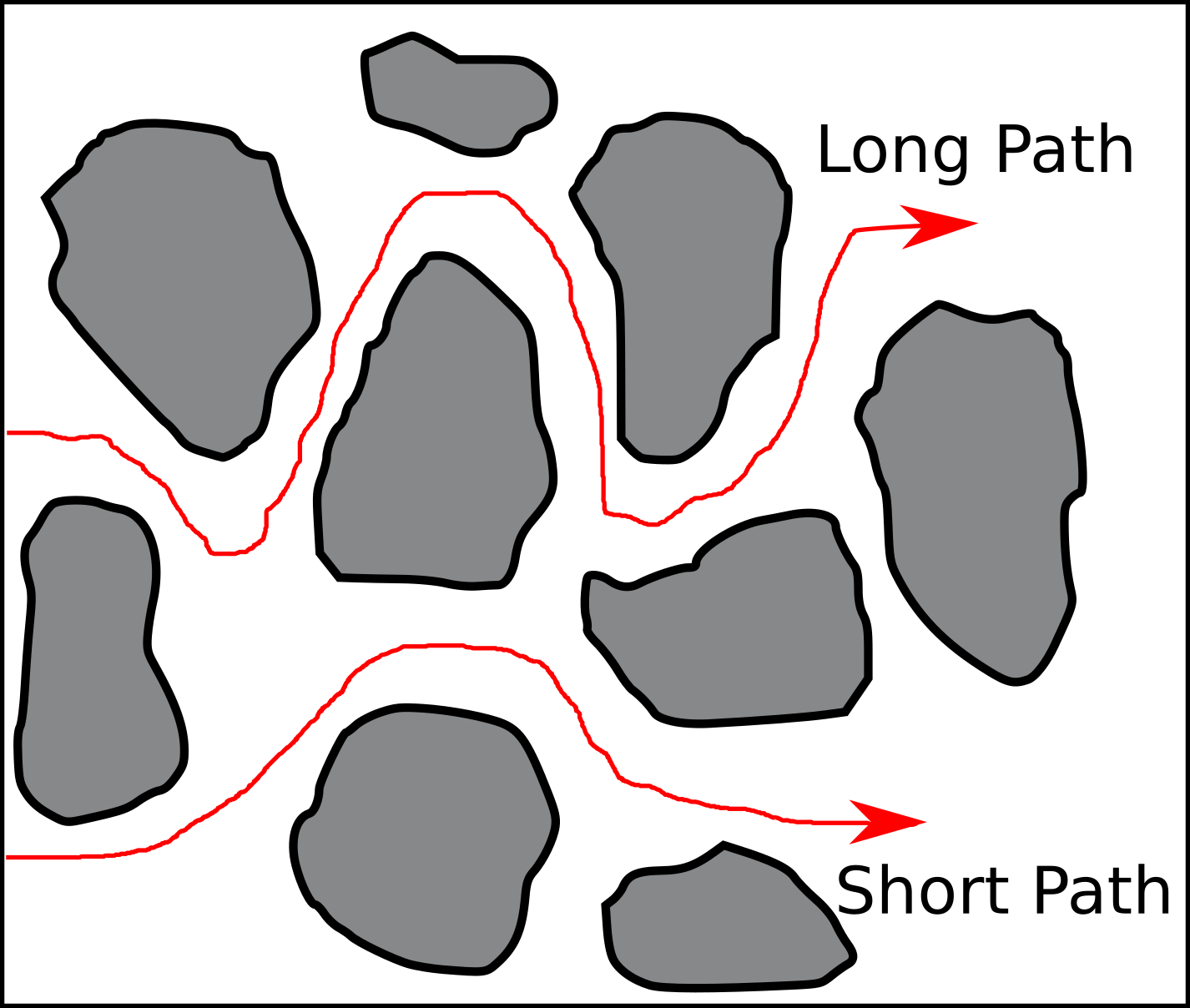
In through-diffusion tests, diffusion is monitored from an external source reservoir, through a clay sample, into an external target reservoir. As the sample typically is sandwiched between two confining filters, the full set-up can be abstracted as transport across three conductive components, coupled in series (filter-clay-filter).

Solving this problem — which is not specifically related to diffusion in clay, and applies equally well to e.g. electric currents or laminar fluid flow — the steady-state flux can be written as (for details, see appendix)
\begin{equation} j = D_\mathrm{e}^\mathrm{clay}\frac{1}{1+\omega} \frac{c_\mathrm{source}}{L_\mathrm{clay}} \tag{1} \end{equation}
where \(\omega\) is the relative filter resistance
\begin{equation} \omega =D_\mathrm{e}^\mathrm{clay}\left (\frac{1}{D_\mathrm{e}^\mathrm{filter1}} + \frac{1}{D_\mathrm{e}^\mathrm{filter2}} \right ) \frac{L_\mathrm{filter}}{L_\mathrm{clay}} \tag{2} \end{equation}
Here \(D_e\) denotes the effective diffusivity for the different components1, \(c_\mathrm{source}\) is the constant source reservoir concentration, \(L_\mathrm{clay}\) is the length of the clay sample, and \(L_\mathrm{filter}\) is the length of the filters (we assume that the two filters have the same length).
Eq. 1 shows that in the limit \(\omega \ll 1\), the flux is expressed solely in terms of clay parameters2
\begin{equation} j = D_\mathrm{e}^\mathrm{clay}\cdot \frac{c_\mathrm{source}} {L_\mathrm{clay}} \end{equation}
In the other limit (\(\omega \gg 1\)), the flux is instead completely controlled by the filters,
\begin{equation} j = \frac{D_\mathrm{e}^\mathrm{filter1} \cdot D_\mathrm{e}^\mathrm{filter2}} { D_\mathrm{e}^\mathrm{filter1}+D_\mathrm{e}^\mathrm{filter2}} \cdot \frac{c_\mathrm{source}}{L_\mathrm{filter}} \end{equation}
i.e. independent of any clay parameters.
It is thus clear that through-diffusion tests should be designed to have \(\omega\) reasonably small; preferably, one should have \(\omega \ll 1\), which allows for leaving the filters out of the analysis.
While filter parameters in practice are limited to a quite small range for a given ion3, \(D_\mathrm{e}^\mathrm{clay}\) is known to grow indefinitely for many cations, as the background concentration tends to zero1. Consequently, for such ions, there always exists a background concentration limit, beyond which the filters completely control the resulting flux (i.e. where \(\omega \gg 1\)).
Even though the effect of filters in through-diffusion tests has been identified for a
long time, there are numerous examples in the bentonite literature where filter influence is ignored, or not fully identified, leading to erroneous interpretations. For example, when describing through-diffusion tests with strontium in Boom Clay, Altmann et al. (2012) write
The resulting \(\alpha\) value of \(\sim 440\) corresponds to a \(K_d\) value similar to that measured on dispersed and intact Boom Clay. However, if this \(\alpha\) is used to estimate the corresponding \(D_e\) value via \(D_e = \alpha\cdot D_a\), the value obtained is \(\sim 45\) times higher than \(D_e(\mathrm{HTO})\), which is an unrealistically large difference. This is probably because the necessary conditions for calculating \(D_e\) by Fick’s law were not satisfied as indicated by the fact that the concentration profiles measured at the end of the through-diffusion experiment were unexpectedly ‘flat’, i.e. did not vary in a linear fashion between the surfaces in contact with the source and sink solutions. The reason for this behaviour is not yet known.
But a “flat” concentration profile is a key signature of filters limiting the flux, as the (external) concentration difference across the clay is (see appendix)
\begin{equation} c_\mathrm{in} – c_\mathrm{out} = \frac{c_\mathrm{source}}{1+\omega} \end{equation}
which approaches zero when \(\omega\) becomes large.
Consequently, the reported behavior strongly indicates that Boom Clay has a very high transport capacity for strontium under the right conditions (the test was performed with a sodium background concentration of approximately 0.02 M), leading to the filters limiting the flux. This, in turn, implies that the value for \(D_e\) in the clay is underestimated, rather than being “unrealistically large”.
What is demonstrated in this test — but not concluded — is that the principal diffusion mechanism in Boom Clay is the same as in compacted bentonite: ions assumed “sorbed” contribute to — and probably dominate — the diffusive flux. The traditional sorption-diffusion model is not valid for Boom Clay.
Glaus et al. (2007) clearly demonstrate filter influence on Na diffusion in Na-montmorillonite, performed over a large range of \(\mathrm{NaClO_4}\) background concentrations. The concentration profiles across the samples at the time of termination look like this4

The profiles become increasingly “flat” with decreasing background concentration, demonstrating an increasing transport capacity of the clay (demonstrating this transport capacity was the main purpose of the study). The tests in Glaus et al. (2007) are analyzed assuming a filter-clay-filter configuration, with identical diffusivities for the two filters (for a given test). The clay component is described using the traditional sorption-diffusion model5. From the reported fitted model parameters, we can calculate the corresponding relative filter resistances, using eq. 2. The result is as follows (all these samples have \(L_\mathrm{clay}=5.4\) mm and \(L_\mathrm{filter}=1.55\) mm.)
| \(C_\mathrm{bkg}\) | (\(\mathrm{mol/m^3}\)) | 10 | 100 | 500 | 700 | 1000 |
| Reported | ||||||
| \(D_\mathrm{e}^\mathrm{clay}\) | (\(10^{-10}\;\mathrm{m^2/s}\)) | 14 | 3.7 | 0.86 | 0.53 | 0.38 |
| \(D_\mathrm{e}^\mathrm{filter}\) | (\(10^{-10}\;\mathrm{m^2/s}\)) | 0.86 | 1.0 | 0.86 | 0.86 | 0.86 |
| Calculated | ||||||
| \(\omega\) | (-) | 9.3 | 2.1 | 0.6 | 0.4 | 0.3 |
Indeed, \(\omega \gg 1\) for the test performed at 10 mM \(\mathrm{NaClO_4}\), and filters fully control the flux. Filter influence is also significant in the test at 100 mM (\(\omega = 2.1\)), while the effect is less important in the tests at higher background concentration. These results fully reflect the appearance of the concentration profiles above.
The filter influence is also clearly seen in the behavior of the outfluxes at the different background concentrations (dotted graphs)

For the tests at high background concentration (i.e. small \(\omega\)), steady-state6 is reached in about 8 – 10 days. In the 10 mM-test, on the other hand, the system is far from steady-state even after 45 days7 — the outflux is still increasing, even though the source concentration (dash-dotted graphs) has dropped significantly. A prolonged transient state is thus another key signature of filters limiting the flux.
This prolonged transient appears because the clay has to be “filled up” with ions before a steady-state can be established. It is important not to confuse this effect with that of retardation due to increased “sorption”: here, it is the filters that cannot “fill up” the clay fast enough, while the diffusive transport capacity of the clay actually increases with increasing “sorption”. Note that this increased transport capacity is not due to increased diffusivity, but exactly because the clay accommodates an increasing amount of tracers as the background concentration decreases.
For the most part, Glaus et al. (2007) treat the filter influence adequately, allowing them to draw correct conclusions regarding diffusion in compacted bentonite. Going into detail, however, I think there is some inconsistency in the parameters, demonstrating the inherent difficulties with handling cation through-diffusion at low ionic strength. \(K_d\) has, as far as I see, been used as a free fitting parameter in the modeling of the tests.8 But for the specific case of sodium tracers diffusing in pure sodium montmorillonite, this parameter is constrained by the simple relation (which also is derived in the article)
\begin{equation} K_d = \frac{\mathrm{CEC}} {1\;\mathrm{eq/mol}} \cdot \frac{1} {C_\mathrm{bkg}} \tag{3} \end{equation}
where \(C_{bkg}\) denotes the background concentration, and CEC is the cation exchange capacity. The reported \(K_d\) values, thus corresponds to these CEC values
| \(C_\mathrm{bkg}\) | (\(\mathrm{mol/m^3}\)) | 10 | 100 | 500 | 700 | 1000 |
| Reported | ||||||
| \(K_d\) | (\(10^{-3}\) \(\mathrm{m^3/kg}\)) | 46 | 7.3 | 1.8 | 1.2 | 0.74 |
| Calculated | ||||||
| CEC | (eq/kg) | 0.46 | 0.73 | 0.90 | 0.84 | 0.74 |
As the documented CEC for the used material (purified “Milos” montmorillonite) is \(\sim 0.88\) eq/kg, this evaluation indicates that the fitted \(K_d\) is significantly underestimated for the test performed at 10 mM.
The reason for this underestimation can be further investigated by using the end values of the recorded clay concentration profile, and assuming the CEC value (i.e. assuming \(K_d\), using eq. 3). From the definition of \(K_d\) we can thereby calculate \(c_\mathrm{in}\) and \(c_\mathrm{out}\).
| \(C_\mathrm{bkg}\) | (\(\mathrm{mol/m^3}\)) | 10 | 100 | 500 | 700 | 1000 |
| Reported | ||||||
| \(s_{in}\) | (\(10^{-12}\) mol/kg) | 88.5 | 38.5 | 12.2 | 9.3 | 7.8 |
| \(s_{out}\) | (\(10^{-12}\) mol/kg) | 76.3 | 17.4 | 1.4 | 1.1 | \(\sim 0\) |
| \(c_{source}\) | (\(10^{-9}\) \(\mathrm{mol/m^3}\)) | 3.1 | 10.5 | 8.1 | 7.7 | 9.4 |
| Assumed | ||||||
| \(K_d\) | (\(10^{-3}\) \(\mathrm{m^3/kg}\)) | 88 | 8.8 | 1.76 | 1.26 | 0.88 |
| Calculated | ||||||
| \(c_{in}\) | (\(10^{-9}\) \(\mathrm{mol/m^3}\)) | 1.0 | 4.4 | 6.9 | 7.4 | 8.9 |
| \(c_{out}\) | (\(10^{-9}\) \(\mathrm{mol/m^3}\)) | 0.9 | 2.0 | 0.8 | 0.9 | \(\sim 0\) |
| \(\omega\) | (-) | 21.36 | 3.37 | 0.31 | 0.19 | \(\sim 0\) |
This calculation gives a concentration drop across the inlet filter (\(c_\mathrm{source} – c_\mathrm{in}\)) that is considerably larger than half the value of the concentration in the source reservoir (\(c_\mathrm{source}\)), for the tests made at 10 mM and 100 mM. Such a behavior is impossible if the diffusivities of the two filters are identical! This reevaluation thus suggests that it is not strictly valid to assume identical filter diffusivities when evaluating these kinds of tests. Of course, if the tests are performed under conditions with small \(\omega\), this assumption will make little difference, because the filter influence is anyway small. But under conditions with \(\omega \gg 1\), the exact values of both filter diffusivities will significantly influence the analysis. The concentration profiles across the filters in the 10 mM case can be illustrated like this

The main achievement in Glaus et al. (2007) is that they, despite filter transport complications, manage to verify that the effective diffusivity in the clay, both for sodium and strontium tracers, scale with sodium background concentration as
\begin{equation} D_\mathrm{e}^\mathrm{clay} \propto \frac{1}{C_\mathrm{bkg}^Z} \tag{4} \end{equation}
where \(Z\) is the valency of the tracer (i.e., \(Z = 1\) for sodium, and \(Z = 2\) for strontium). Not only is this relation crucial for understanding bentonite diffusion at a deeper level, it also allows for assessing filter influence on evaluated diffusion parameters in general. Eq. 4 implies a dramatic effect of the background concentration on the relative filter resistance for strontium (note from eq. 2 that also \(\omega\) will scale as \(C_\mathrm{bkg}^{-Z}\)): lowering the background concentration e.g. from 0.5 M to 0.1 M, increases \(\omega\) by a factor of 25; lowering it from 0.5 M to 0.01 M gives a factor of 2500! (I don’t think it is a coincidence that the strontium tests in Glaus et al. (2007) are restricted to \(C_\mathrm{bkg}\ge 0.5\;\mathrm{M}\).)
Molera and Eriksen (2002) report diffusion parameters evaluated for strontium in “MX-80” bentonite of various densities and in the background concentration (\(\mathrm{NaClO_4}\)) range 0.5 M – 0.01 M. The tests were evaluated using the traditional sorption-diffusion model for the clay, and by taking the filters into account. The filter diffusivities were, however, assumed identical in the two filters, and kept constant (for a given ion) in all models. From the reported fitted parameters, we can evaluate \(\omega\), using eq. 2 (they used “\(D_\mathrm{a}\)” as fitting parameter rather than \(D_\mathrm{e}^\mathrm{clay}\), but these are related via \(D_\mathrm{e}^\mathrm{clay} = D_\mathrm{a}\left(\phi + \rho K_d\right)\))
| Reported | Calculated | ||||
| Density | \(C_\mathrm{bkg}\) | \(D_\mathrm{a}\) | \(K_d\) | \(D_\mathrm{e}^\mathrm{clay}\) | \(\omega\) |
| (\(\mathrm{kg/m^3}\)) | (\(\mathrm{mol/m^3}\)) | (\(10^{-10}\;\mathrm{m^2/s}\)) | (\(10^{-3}\;\mathrm{m^3/kg}\)) | (\(10^{-10}\;\mathrm{m^2/s}\)) | (-) |
| 400 | 100 | 0.43 | 110 | 19.3 | 6.8 |
| 800 | 100 | 0.35 | 150 | 42.2 | 14.8 |
| 800 | 500 | 0.40 | 15 | 5.1 | 1.8 |
| 1200 | 10 | 0.21 | 500 | 126 | 44.2 |
| 1200 | 100 | 0.18 | 130 | 28.2 | 9.9 |
| 1200 | 500 | 0.25 | 13 | 4.0 | 1.4 |
| 1600 | 10 | 0.14 | 1200 | 269 | 94.2 |
| 1600 | 100 | 0.10 | 90 | 14.4 | 5.1 |
| 1600 | 500 | 0.20 | 15 | 4.9 | 1.7 |
| 1800 | 100 | 0.09 | 80 | 13.0 | 4.6 |
| 1800 | 500 | 0.12 | 15 | 3.3 | 1.1 |
In this evaluation is used \(D_\mathrm{e}^\mathrm{filter} = 0.925 \cdot 10^{-10}\;\mathrm{m^2/s}\), \(L_\mathrm{filter} = 0.81\) mm, and \(L_\mathrm{clay} = 5.0\) mm for all tests.
Filter transport dominates (\(\omega \gg 1\)) in all but the tests performed at 500 mM (and even in these tests, there is significant filter influence). It can therefore be questioned whether the parameters have been adequately evaluated. That the fitted parameter values (\(K_d\) and/or \(D_\mathrm{a}\)) are not adequate is seen when plotting \(D_\mathrm{e}^\mathrm{clay}\) against background concentration (the “expected dependency” line assumes the \(D_\mathrm{e}^\mathrm{clay}\) value of the 1200 \(\mathrm{kg/m^3}\) sample at 500 mM background concentration).

The \(D_\mathrm{e}^\mathrm{clay}\) values do not obey Glaus’ relation, which they are expected to do, as “MX-80” is a sodium dominated clay. Note that the above plot suggests that \(D_\mathrm{e}^\mathrm{clay}\) in Molera and Eriksen (2002) at background 0.01 M may be underestimated by roughly two orders of magnitude! Nevertheless, the actual clay diffusivity estimated in this study (unfortunately interpreted as “apparent” diffusivity) compares relatively well with other measurements, e.g. Kim et al. (1993), indicating that the underestimation of \(D_\mathrm{e}^\mathrm{clay}\) is rooted in a similar underestimation of \(K_d\).
Results like those of Glaus et al. (2007) and Molera and Eriksen (2002) show that cation through-diffusion tests at low background concentration should be avoided if possible: Both studies explicitly take into account filters when evaluating model parameters, yet the evaluations can be demonstrated to be inconsistent in the low background concentration limit. Although experimental design — as well as corresponding modeling — can be of various quality, the low concentration limit is fundamental: no matter how rigorous the analysis, the results will still be uncertain, simply because the experiment itself conveys less and less information on transport parameters in the clay.
Thus, unless the explicit purpose is to explore the low background concentration limit, it is better to stay away from it, thereby reducing the risk of drawing incorrect conclusions. An example of using data influenced by filter resistance to draw far-reaching conclusions regarding bentonite structure is found in Tinnacher et al. (2016).
This study uses the result from a single through-diffusion test in pure Na-montmorillonite (prepared from SWy-2) at 800 \(\mathrm{kg/m^3}\)9 to review “single porosity models”, and to argue for that this system is dominated by bulk water (\(>70\%\)) — a rather bizarre conclusion, in my opinion.
The test was done with a background electrolyte of 0.1 M NaCl, by adding a small amount of \(\mathrm{CaBr_2}\) (1 mM) to the source reservoir, and monitoring the accumulation of calcium and bromide in the target reservoir (which was kept virtually tracer free by frequent replacement). The recorded normalized outflux of calcium looks like this10

As this test concerns diffusion of a di-valent cation at relatively low ionic strength, there are strong reasons to suspect that filter resistance influences the flux evolution. If I understand correctly, this test was actually performed using the exact same equipment as used in the study by Molera and Eriksen (2002), where we evaluated a value \(\omega = 14.8\) for strontium at the same conditions, albeit in a different clay material (see above).
But using the reported model parameters in Tinnacher et al. (2016) gives \(\omega = 0.77\) (\(D_\mathrm{e}^\mathrm{clay} = 2.06\cdot 10^{-10}\; \mathrm{m^2/s}\), \(D_\mathrm{e}^\mathrm{filter} = 0.85\cdot 10^{-10}\; \mathrm{m^2/s}\), \(L_\mathrm{filter} = 0.79\) mm, and \(L_\mathrm{clay} = 5\) mm). This result — indicating only moderate filter influence — is a bit surprising, given the results from Molera and Eriksen (2002), and given that calcium appears to diffuse faster than strontium in Na-montmorillonite.
However, these model parameters are not consistent with the recorded steady-state flux. The normalized flux (\(j/c_\mathrm{source}\)) can be calculated from eq. 1
\begin{equation} \frac{j}{c_\mathrm{source}} = \frac{1}{\frac{L_\mathrm{clay}}{D_\mathrm{e}^\mathrm{clay}} + \frac{2\cdot L_\mathrm{filter}}{D_\mathrm{e}^\mathrm{filter}}} = 2.33\cdot 10^{-8} \;\mathrm{m/s} \end{equation}
which is significantly smaller than the observed flux of \(3.5 \cdot 10^{-8} \;\mathrm{m/s}\). In order to match the observed flux instead requires \(D_\mathrm{e}^\mathrm{clay} = 5.0\cdot10^{-10}\; \mathrm{m^2/s}\), indicating significant filter influence after all (\(\omega = 1.86\)).
Of course, the calculated flux could match the observed flux by instead altering the filter diffusivity (or by altering both the filter and clay diffusivities). But matching the fluxes by only altering the filter diffusivity requires \(D_\mathrm{e}^\mathrm{filter} = 3.67\cdot 10^{-10}\; \mathrm{m^2/s}\), which is unrealistically large (it corresponds to a geometric factor of unity and porosity 0.46).
This analysis shows that the evaluated value for \(D_\mathrm{e}^\mathrm{clay}\) for calcium in Tinnacher et al. (2016) is conditioned on the adopted value for filter diffusivity, and that the experiment most probably is significantly influenced by filter limitations. It is consequently not suited for reviewing “single porosity models”.11
Footnotes
[1] Note that for bentonite, \(D_\mathrm{e}^\mathrm{clay}\) is not a real diffusion coefficient! But, since it is the parameter that quantifies the steady-state flux given the external concentration difference (\(c_\mathrm{in} – c_\mathrm{out}\)), it is precisely what is required in this analysis.
[2] Except for \(c_\mathrm{source}\), of course; without a source concentration there wouldn’t be much flux.
[3] Typically, \(L_\mathrm{filter} \sim 1\) mm and \(D_\mathrm{e}^\mathrm{filter} \sim 0.1\cdot D_0\), where \(D_0\) is the corresponding diffusivity in pure bulk water.
[4] The data underlying these plots are found in the supporting information to Glaus et al. (2007). There it is, however, presented as “normalized” concentrations, without a full description of how this normalization has been performed. I have used the concentration values as plotted, but scaled them spatially to the proper sample length (5.4 mm).
[5] In contrast to basically any other diffusion study, the traditional model is (in a sense) concluded invalid in Glaus et al. (2007). For this reason, the quantity usually labeled \(D_\mathrm{e}\) is in this paper labeled \(^cD\), where “c” is short for “conditional”. Here, we continue to label this quantity \(D_\mathrm{e}^\mathrm{clay}\), in order to relate it to other studies.
[6] These tests were performed with a changing source reservoir concentration (also plotted), and the system is never strictly in steady-state, as reflected in a weak decay of the flux at long times. Still, there is a distinct difference between this “quasi”-steady-state and the initial transient state, and the presented theoretical analysis is still useful to apply.
[7] The supporting information unfortunately leaves out the data between days 45 and 100.
[8] This quantity is referred to as \(R_d\) in Glaus et al. (2007).
[9] Tinnacher et al. (2016) states the density as both 800 \(\mathrm{kg/m^3}\) and 790 \(\mathrm{kg/m^3}\). I have used the former value.
[10] Oddly, the “flux” data is presented in Tinnacher et al. (2016) without correcting for a certain amount of “dead” volume that is not being exchanged during the target concentration measurements. Consequently, what is called “flux” in the article is strictly not the real flux, and all model curves look like a hedgehog’s back. In the plot presented here, this correction has been performed, and it does not exactly resemble the published plot. In practice, these differences are not important for the point I’m trying to make: the steady-state flux is still the same.
[11] I mean that diffusion studies in general are not very useful on their own for drawing conclusions on e.g. the presence of bulk water in bentonite. But that’s a separate discussion.
Appendix: Derivation of eqs. 1 and 2
We assume that the steady-state flux in any of the conductive units is linearly dependent on the concentration difference applied across it (\(\Delta c\))
\begin{equation} j = -\frac{1}{R}\Delta c \end{equation}
where \(R\) is the transfer resistance.
With constant source and target concentrations, the steady-state flux in the system under consideration (filter-clay-filter) can be expressed using any of the involved units (the flux is the same everywhere)
\begin{equation} j = \frac{1}{R_\mathrm{filter1}} \cdot \left(c_\mathrm{source} – c_\mathrm{in}\right) = \frac{1}{R_\mathrm{clay}} \cdot \left(c_\mathrm{in} – c_\mathrm{out} \right) = \frac{1}{R_\mathrm{filter2}}\cdot c_\mathrm{out} \tag{A1} \end{equation}
Here is also assumed, without loss of generality, that the target reservoir concentration is zero.
Solving for \(c_\mathrm{in}\) and \(c_\mathrm{out}\) gives
\begin{equation} c_\mathrm{in} = \frac{R_\mathrm{clay} + R_\mathrm{filter2}} {R_\mathrm{filter1} + R_\mathrm{clay}+ R_\mathrm{filter2} } c_\mathrm{source} \end{equation}
\begin{equation} c_\mathrm{out} = \frac{R_\mathrm{filter2} }{R_\mathrm{filter1} + R_\mathrm{clay} + R_\mathrm{filter2} } c_\mathrm{source} \end{equation}
Defining the relative filter resistance as
\begin{equation} \omega = \frac{R_\mathrm{filter1} + R_\mathrm{filter2}} {R_\mathrm{clay}} \end{equation}
we can express the concentration drop across the clay as
\begin{equation} c_\mathrm{in} – c_\mathrm{out} = \frac{R_\mathrm{clay}} {R_\mathrm{filter1} + R_\mathrm{filter2} + R_\mathrm{clay}} c_\mathrm{source} = \frac{c_\mathrm{source}}{1+\omega} \end{equation}
Specializing to the case of Fickian diffusion, the resistances may be expressed as
\begin{equation} R = \frac{L}{D_\mathrm{e}} \tag{A2} \end{equation}
and the steady-state may be written (using the middle expression in eq. A1)
\begin{equation} j = D_\mathrm{e}^\mathrm{clay}\frac{1}{1+\omega} \frac{c_\mathrm{source}} {L_\mathrm{clay}} \end{equation}
which is eq. 1 above.
Using eq. A2, the relative filter resistance becomes (assuming equal filter lengths)
\begin{equation} \omega = D_\mathrm{e}^\mathrm{clay} \left ( \frac{1}{D_\mathrm{e}^\mathrm{filter1}} + \frac{1}{D_\mathrm{e}^\mathrm{filter2}} \right ) \frac{L_\mathrm{filter}}{L_\mathrm{clay}} \end{equation}
which is eq. 2 above.