Category Archives: Equilibrium tests

Assessment of chloride equilibrium concentrations: Muurinen et al. (1988)

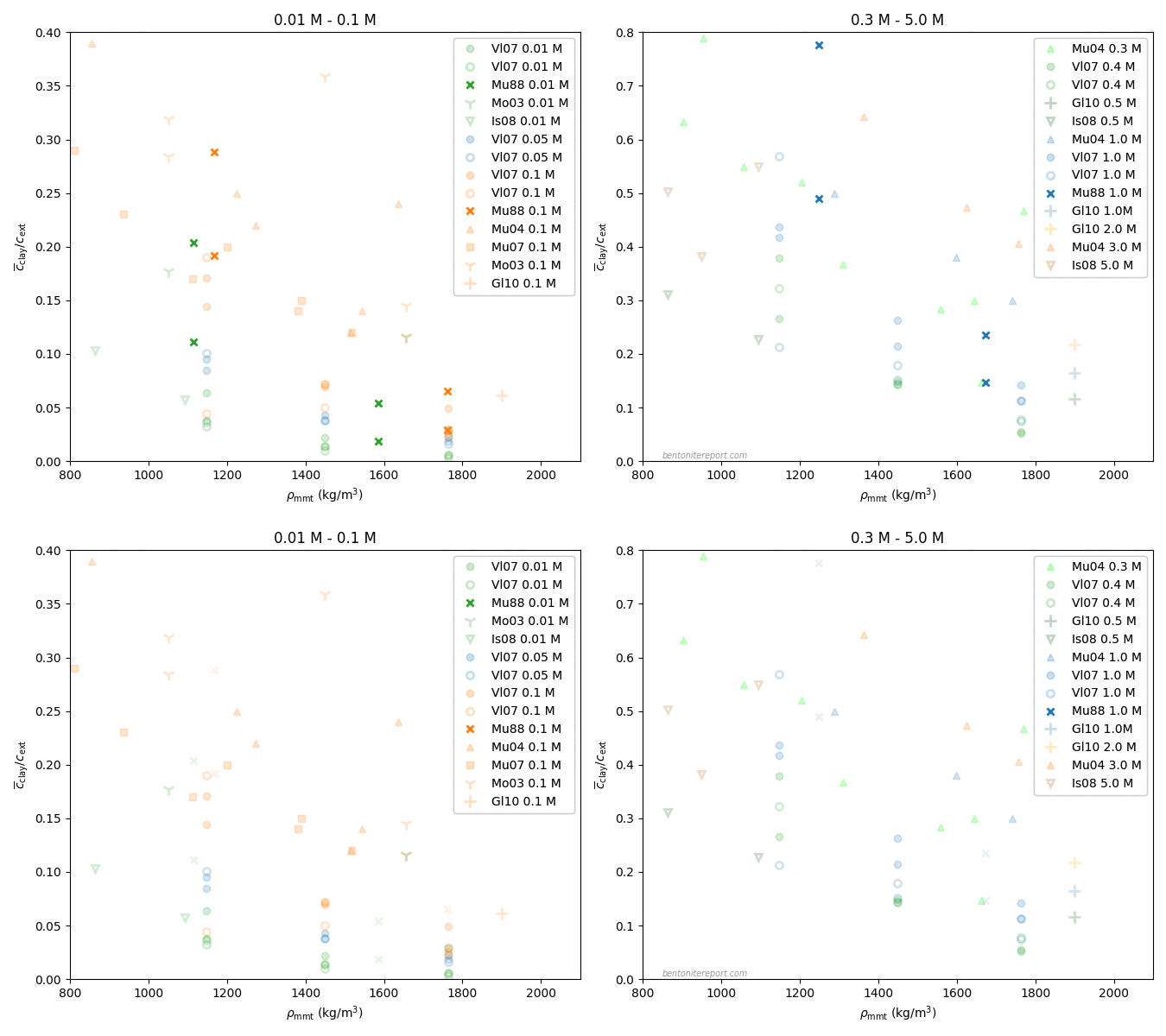
In the ongoing assessment of chloride equilibrium concentrations in bentonite, we here take a closer look at the study by Muurinen et al. (1988), in the following referred to as Mu88.1 In the quite messy plot containing all reported chloride equilibrium concentrations, we thus investigate the twelve points indicated here

Mu88 points highlighted in plot with all chloride equilibrium data

Mu88 performed both chloride and uranium through-diffusion tests on “MX-80” bentonite, as well as sorption tests. Here we focus solely on the chloride diffusion. We also disregard one diffusion test series that does not vary external concentration (it was conducted with an unspecified “artificial groundwater” and varied sample density).

Left are two test series performed with nominal sample densities 1.2 g/cm3 and 1.8 g/cm3, respectively. For each of these densities, chloride through-diffusion tests were performed with external NaCl concentrations of 0.01 M, 0.1 M, and 1.0 M, respectively. The samples were cylindrical with a diameter of 3.0 cm, and a length of 1.5 cm, giving a volume of 10.6 cm3. To refer to a specific test or sample, we use the nomenclature “nominal density/external concentration”, e.g. the test performed at nominal density 1.2 g/cm3 and external solution 0.1 M is referred to as “1.2/0.1”.

Uncertainty of bentonite samples

“MX-80” is not the name of some specific standardized material, but simply a product name.2 It is quite peculiar that that “MX-80” nevertheless is a de facto standard in the research field for clay buffers in radwaste repositories. But, being a de facto standard, several batches of bentonite with this name have been investigated and reported throughout the years. We consequently have some appreciation for its constitution, and the associated variation.

In Mu88, the material used is only mentioned by name, and it is only mentioned once (in the abstract!). We therefore can’t tell which of the studies that is more appropriate to refer to. Instead, let’s take a look at how “MX-80” has been reported generally.

ReportBatch yearMmt contentCECNa-content
(%)(eq/kg)(%)
TR-06-30 (“WySt”)198082.50.7683
NTR 83-12< 198375.50.7686
TR-06-30 (“WyL1”)199579.50.77
TR-06-30 (“WyL2”)199979.80.7571
TR-06-30 (“WyR1”)200182.70.7575
TR-06-30 (“WyR2”)200180.00.7171
NTB 01-08< 20020.79*85
WR 2004-023< 200480 — 850.84*65
*) These values were derived from summing the exchangeable ions, and are probably overestimations.

Montmorillonite content

Reported montmorillonite content varies in the range 75 — 85%. For the present context, this primarily gives an uncertainty in adopted effective montmorillonite dry density, which, in turn, is important for making relevant comparison between bentonite materials with different montmorillonite content. For the “MX-80” used in Mu88 we here assume a montmorillonite content of 80%. In the table below is listed the corresponding effective montmorillonite densities when varying the montmorillonite content in the range \(x =\) 0.75 — 0.85, for the two nominal dry densities.

Dry densityEMDD (\(x\)=0.75)EMDD (\(x\)=0.80)EMDD (\(x\)=0.85)
(g/cm3)(g/cm3)(g/cm3)(g/cm3)
1.21.011.051.09
1.81.611.661.70

The uncertainty in montmorillonite content thus translates to an uncertainty in effective montmorillonite dry density on the order of 0.1 g/cm3.

Cation population

While reported values of the cation exchange capacity of “MX-80” are relatively constant, of around 0.75 eq/kg,4 the reported fraction of sodium ions is seen to vary, in the range 70 — 85 %. The remaining population is mainly di-valent rare-earth metal ions (calcium and magnesium). This does not only mean that different studies on “MX-80” may give results for quite different types of systems, as the mono- to di-valent ion ratio may vary, but also that samples within the study may represent quite different systems. We examine this uncertainty below, when discussing the external solutions.

Soluble calcium minerals

The uncertainty of how much divalent cations are available is in fact larger than just discussed. “MX-80” is reported to contain a certain amount of soluble calcium minerals, in particular gypsum. These provide additional sources for divalent ions, which certainly will be involved in the chemical equilibration as the samples are water saturated. Reported values of gypsum content in “MX-80” are on the order of 1%. With a molar mass of 0.172 kg/mol, this contributes to the calcium content by \(2\cdot 0.01/0.172\) eq/kg \(\approx 0.12\) eq/kg, or about 16% of the cation exchange capacity.

Sample density

The samples in Mu88 that we focus on have nominal dry density of 1.2 and 1.8 g/cm3. The paper also reports measured porosities on each individual sample, listed in the below table together with corresponding values of dry density5

Test\(\phi\)\(\rho_d\)
(-)(g/cm3)
1.2/0.010.541.27
1.2/0.10.521.32
1.2/1.00.491.40
1.8/0.010.371.73
1.8/0.10.311.89
1.8/1.00.341.81

We note a substantial variation in measured density for samples with the same nominal density: for the 1.2 g/cm3 samples, the standard deviation is 0.06 g/cm3, and for the 1.8 g/cm3 samples it is 0.07 g/cm3. Moreover, while the mean value for the 1.8 g/cm3 samples is close to the nominal value (1.81 g/cm3), that for the 1.2 g/cm3 samples is substantially higher (1.33 g/cm3).

It is impossible to know from the information provided in Mu88 if this uncertainty is intrinsic to the procedure of preparing the samples, or if it is more related to the procedure of measuring the density at test termination.6

Uncertainty of external solutions

Mu88 do not describe how the external solutions were prepared. We assume here, however, that preparing pure NaCl solutions gives no significant uncertainty.

Further, the paper contains no information on how the samples were water saturated, nor on the external solution volumes. Since samples with an appreciable amount of di-valent cations are contacted with pure sodium solutions, it is unavoidable that an ion exchange process is initiated. As we don’t know any detail of the preparation process, this introduces an uncertainty of the exact aqueous chemistry during the course of a test.

To illustrate this problem, here are the results from calculating the exchange equilibrium between a sample initially containing 30% exchangeable charge in form of calcium (70% sodium), and external NaCl solutions of various concentrations and volumes

calcium remaining in the bentonite as a function of inital external NaCl concentration for various volumes

In these calculations we assume a sample of density 1.8 g/cm3 with the same volume as in Mu88 (10.6 cm3), a cation exchange capacity of 0.75 eq/kg, and a Ca/Na selectivity coefficient of 5.

In a main series, we varied the external volume between 50 and 1000 ml (solid lines). While the solution volume naturally has a significant influence on the process, it is seen that the initial calcium content essentially remain for the lowest concentration (0.01 M). In contrast, for a 1.0 M solution, a significant amount of calcium is exchanged for all the solution volumes.

The figure also shows a case for sample density 1.2 g/cm3 (dashed line), and a scenario where equilibrium has been obtained twice, with a replacement of the first solution (to a once again pure NaCl solution) (dot-dashed line).

The main lesson from these simulations is that the actual amount of di-valent ions present during a diffusion test depends on many details: the way samples were saturated, volume of external solutions, if and how often solutions were replaced, time, etc. It is therefore impossible to state the exact ion population in any of the tests in Mu88. But, guided by the simulations, it seems very probable that the tests performed at 0.01 M contain a substantial amount of di-valent ions, while those performed at 1.0 M probably resemble more pure sodium systems.

The only information on external solutions in Mu88 is that the “solution on the low concentration side was changed regularly” during the course of a test. This implies that the amount of di-valent cations may not even be constant during the tests.

Uncertainty of diffusion parameters

The diffusion parameters explicitly listed in Mu88 are \(D_e\) and “\(D_a\)”, while it is implicitly understood that they have been obtained by fitting the effective porosity model to outflux data and the measured clay concentration profile in the final state. “\(D_a\)” is thus really the pore diffusivity \(D_p\),7 and relates to \(D_e\) as \(D_e = \epsilon_\mathrm{eff} D_p\), where \(\epsilon_\mathrm{eff}\) is the so-called “effective porosity”. In a previous blog post, we discussed in detail how anion equilibrium concentrations can be extracted from through-diffusion tests, and the results derived there is used extensively in this section.

Rather than fitting the model to the full set of data (i.e. outflux evolution and final state concentration profile), diffusion parameters in Mu88 have been extracted in various limits.

Evaluation of \(D_e\) in Mu88

The effective diffusivity was obtained by estimating the steady-state flux, dividing by external concentration difference of the tracer, and multiplying by sample length \begin{equation} D_e = \frac{j^\mathrm{ss}\cdot L}{c^\mathrm{source}}\tag{1} \end{equation}

Here it is assumed that the target reservoir tracer concentration can be neglected (we assume this throughout). Eq. 1 is basically eq. 1 in Mu88 (and eq. 8 in the earlier blog post), from which we can evaluate the values of the steady-state flux that was used for the reported values of \(D_e\) (\(A \approx 7.1\) cm2 denotes sample cross sectional area)

Test\(D_e\)\(A\cdot j^\mathrm{ss}/c^\mathrm{source}\)
(\(\mathrm{m^2/s}\))(ml/day)
1.2/0.01\(7.7\cdot 10^{-12}\)0.031
1.2/0.1\(2.9\cdot 10^{-11}\)0.118
1.2/1.0\(1.2\cdot 10^{-10}\)0.489
1.8/0.01\(3.3\cdot 10^{-13}\)0.001
1.8/0.1\(4.8\cdot 10^{-13}\)0.002
1.8/1.0\(4.0\cdot 10^{-12}\)0.016

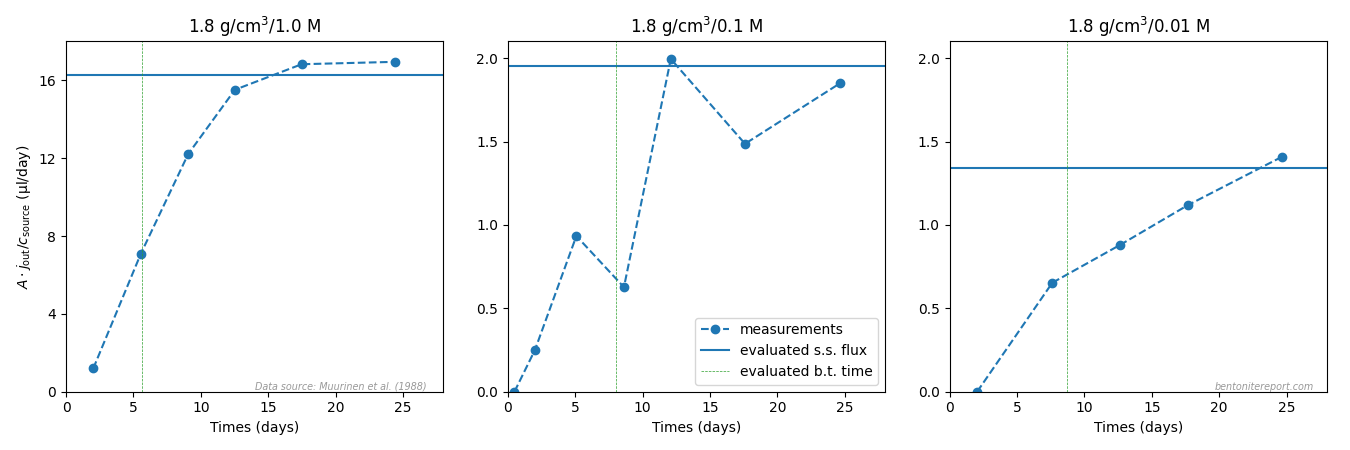
The figure below compares the evaluated values of the steady-state flux with the flux evaluated from the measured target concentration evolution,8 for samples with nominal dry density 1.8 g/cm3 (no concentration data was reported for the 1.2 g/cm3 samples)

outflux vs. time for 1.8 g/cm3 samples in Muurinen et al. (1988)

These plots clearly show that the transition to steady-state is only resolved properly for the test with highest background concentration (1.0 M). It follows that the uncertainty of the evaluated steady-state — and, consequently, of the evaluated \(D_e\) values — increases dramatically with decreasing background concentration for these samples.

Evaluation of \(D_p\) in Mu88

Pore diffusivities were obtained in two different ways. One method was to relate the steady-state flux to the clay concentration profile at the end of the test, giving \begin{equation} D_{p,c} = \frac{j^\mathrm{ss}\cdot L}{\phi\cdot\bar{c}(0)} \tag{2} \end{equation}

where \(\bar{c}(0)\) denotes the chloride clay concentration at the interface to the source reservoir. The quantity in eq. 2 is called “\(D_{ac}\)”7 in Mu88, and this equation is essentially the same as eq. 2 in Mu889 (and eq. 10 in the previous blog post). Using the steady-state fluxes, we can back-calculate the values of \(\bar{c}(0)\) used for this evaluation of \(D_{p,c}\)

Test\(D_{p,c}\)\(A\cdot j^\mathrm{ss}/c^\mathrm{source}\)\(\phi\)\(\bar{c}(0)/c^\mathrm{source}\)
(\(\mathrm{m^2/s}\))(ml/day)(-)(-)
1.2/0.01\(7.0\cdot 10^{-11}\)0.0310.540.204
1.2/0.1\(2.8\cdot 10^{-10}\)0.1180.520.199
1.2/1.0\(5.1\cdot 10^{-10}\)0.4890.490.480
1.8/0.01\(2.0\cdot 10^{-11}\)0.0010.370.045
1.8/0.1\(3.1\cdot 10^{-11}\)0.0020.310.050
1.8/1.0\(5.2\cdot 10^{-11}\)0.0160.340.226

Note that, although we did some calculations to obtain them, the values for \(\bar{c}(0)/c^\mathrm{source}\) in this table are closer to the actual measured raw data (concentrations). We made the calculation above to “de-derive” these values from the reported diffusion coefficients (combining eqs. 1 and 2 shows that \(\bar{c}(0)\) is obtained from the reported parameters as \(\bar{c}(0)/c^\mathrm{source} = D_e/(\phi D_{p,c})\)).

Here are compared the measured concentration profiles for the samples of nominal density 1.8 g/cm3 and the corresponding slopes used to evaluate \(D_{p,c}\) (profiles for the 1.2 g/cm3 samples are not provided in Mu88)

Final state concentration profiles for 1.8 g/cm3 samples in Muurinen et al. (1988)

For background concentrations 1.0 M and 0.1 M, the evaluated slope corresponds quite well to the raw data. For the 0.01 M sample, however, the match is not very satisfactory. I suspect that a detection limit may have been reached for the analysis of the profile of this sample. Needless to say, the evaluated value of \(\bar{c}(0)\) is very uncertain for the 0.01 M sample.

It may also be noted that all measured concentration profiles deviates from linearity near the interface to the source reservoir. This is a general behavior in through-diffusion tests, which I am quite convinced of is related to sample swelling during dismantling, but there are also other suggested explanations. Here we neglect this effect and relate diffusion quantities to the linear parts of profiles, but this issue should certainly be treated in a separate discussion. Update (220407): non-linear profiles are discussed here.

\(D_p\) was also evaluated in a different way in Mu88, by measuring what we here will call the breakthrough time, \(t_\mathrm{bt}\) (Mu88 call it “time-lag”). This quantity is fairly abstract, and relates to the asymptotic behavior of the analytical expression for the outflux that apply for constant boundary concentrations (we here assume them to be \(c^\mathrm{source}\) and 0, respectively). This expression is displayed in eq. 7 in the previous blog post.

Multiplying the outflux by the sample cross sectional area \(A\) and integrating, gives the accumulated amount of diffused tracers. In the limit of long times, this quantity is, not surprisingly, linear in \(t\) \begin{equation} A\cdot j^\mathrm{ss} \cdot \left(t – \frac{L^2}{6\cdot D_p} \right ) \end{equation}

\(t_\mathrm{bt}\) is defined as the time for which this asymptotic expression is zero. Determining \(t_\mathrm{bt}\) from the measured outflux evolution consequently allows for an estimation of \(D_p\) as \begin{equation} D_{p,t} = \frac{L^2}{6t_\mathrm{bt}} \tag{3} \end{equation}

This quantity is called “\(D_{at}\)” in Mu887 (eq. 3 is eq. 3 in Mu88). With another back calculation we can extract the values of \(t_\mathrm{bt}\) determined from the raw data

Test\(D_{p,t}\)\(t_\mathrm{bt}\)
(\(\mathrm{m^2/s}\))(days)
1.2/0.01\(1.4\cdot 10^{-10}\)3.1
1.2/0.1\(2.0\cdot 10^{-10}\)2.2
1.2/1.0\(3.2\cdot 10^{-10}\)1.4
1.8/0.01\(5.0\cdot 10^{-11}\)8.7
1.8/0.1\(5.4\cdot 10^{-11}\)8.0
1.8/1.0\(7.7\cdot 10^{-11}\)5.6

These evaluated breakthrough times are indicated in the flux plots above for samples of nominal dry density 1.8 g/cm3. For the 0.1 M and 0.01 M samples it is obvious that this value is very uncertain — without a certain steady-state flux it is impossible to achieve a certain breakthrough time. The breakthrough time for the 1.8/1.0 test, on the other hand, simply appears to be incorrectly evaluated: in terms of outflux vs. time, the breakthrough time should be the time where the flux has reached 62% of the steady-state value.10

As no raw data is reported for the 1.2 g/cm3 tests, the quality of the evaluated breakthrough times cannot be checked for them. It may be noted, however, that the evaluated breakthrough times are significantly shorter in this case as compared with the 1.8 g/cm3 tests. Consequently, while the sampling frequency is high enough to properly resolve the transient stage of the outflux evolution for the 1.8g/cm3 tests, it must be substantially higher in order to resolve this stage in the 1.2g/cm3 tests (I guess a rule of thumb is that sampling frequency must be at least higher than \(1/t_{bt}\)).

With the pore diffusivities evaluated from \(t_\mathrm{bt}\) we get a second estimation of \(\bar{c}(0)/c^\mathrm{source}\), using eq. 2. These values are listed in the table below and compared with the direct evaluation from the steady-state concentration profiles.

Test\(\bar{c}(0)/c^\mathrm{source}\)\(\bar{c}(0)/c^\mathrm{source}\)
(breakthrough)(profile)
1.2/0.010.1020.204
1.2/0.10.2790.199
1.2/1.00.7650.480
1.8/0.010.0180.045
1.8/0.10.0290.050
1.8/1.00.1530.226

In a well conducted study these estimates should be similar; \(D_{p,c}\) and \(D_{p,t}\) are, after all, estimations of the same quantity: the pore diffusivity \(D_p\).7 But here we note a discrepancy of approximately a factor 2 between several values of \(\bar{c}(0)\).

It is difficult to judge generally which of the estimations are more accurate, but we have seen that for the 1.8/0.1 and 1.8/0.01 tests, the flux data is not very well resolved, giving a corresponding uncertainty on the equilibrium concentration estimated from the breakthrough time. On the other hand, also the concentration profile is poorly resolved in the case of 0.01 M at 1.8 g/cm3.

However, in cases where the value of \(\bar{c}(0)/c^\mathrm{source}\) is substantial (as for the 1.8/1.0 test and, reasonably, for all tests at 1.2 g/cm3), we expect the estimation directly from the concentration profile to be accurate and robust (as for the 1.8 g/cm3 test at high NaCl concentration). For the 1.2 g/cm3 samples we cannot say much more than this, since Mu88 don’t provide the concentration raw data. For the 1.8/1.0 test, however, we can continue the analysis by fitting the model to all available data.

Re-evaluation by fitting to the full data set

Note that all evaluations in Mu88 are based on making an initial estimation of the steady-state flux, giving \(D_e\) (eq. 1). This value of \(D_e\) (or \(j^{ss}\)) is thereafter fixed in the subsequent estimation of \(D_{p,c}\) (eq. 2). Likewise, an estimation of the steady-state flux is required for estimating the breakthrough time. Here is an animation showing the variation of the model when transitioning from the value of the pore diffusivity estimated from breakthrough time (\(7.7\cdot 10^{-11}\) m2/s), to the value estimated from concentration profile (\(5.2\cdot 10^{-11}\) m2/s) for the 1.8/1.0 test, keeping the steady-state flux fixed at the initial estimation

Note that the axes for the flux is on top (time) and to the right (accumulation rate). This animation confirms that the diffusivity evaluated from breakthrough time in Mu88 gives a way too fast process: the slope of the steady-state concentration profile is too small, and the outflux evolution has a too short transient stage. On the other hand, using the diffusivity estimated from the concentration profiles still doesn’t give a flux that fit very well. The problem is that this fitting is performed with a fixed value of the steady-state flux. By instead keeping the slope fixed at the experimental values, while varying diffusivity (and thus steady state flux), we get the following variation

This animation shows that the model can be fitted well to all data (at least for the 1.8/1.0 test). The problem with the evaluation in Mu88 is that it assumes the steady-state to be fully reached at the later stages of the test. As the above fitting procedure shows, this is only barely true. The experiments could thus have been designed better by conducting them longer, in order to better sample the steady-state phase (and the steady-state flux should have been fitted to the entire data set). Nevertheless, for this sample, the steady-state flux obtained by allowing for this parameter to vary is only slightly different from that used in Mu88 (17.5 rather than 16.3 \(\mathrm{\mu}\)l/day, corresponding to a change of \(D_p\) from \(5.2\cdot10^{-11}\) to \(5.6\cdot10^{-11}\) m2/s). Moreover, this consideration should not be a problem for the 1.2 g/cm3 tests, if they were conducted for as long time as the 1.8 g/cm3 tests, because steady-state is reached much faster (in those tests, sampling frequency may instead be a problem, as discussed above).

As we were able to fit the full model to all data, we conclude that the value of \(\bar{c}(0)/c^\mathrm{source}\) obtained from \(D_{p,c}\) is probably the more robust estimation11, and that there appears to be a problem with how the breakthrough times have been determined. For the 1.8 g/cm3 samples we have demonstrated that this is the case, for the 1.2 g/cm3 we can only make an educated guess that this is the case.

Summary and verdict

We have seen that the results on chloride diffusion in Mu88 suffer from uncertainty from several sources:

  • The “MX-80” material is not that well defined
  • Densities vary substantially for samples at the same nominal density
  • Without knowledge of e.g water saturation procedures and solution volumes, it is impossible to estimate the proper ion population during the course of a test
  • It is, however, highly likely that tests performed at low NaCl concentrations contain substantial amounts of di-valent ions, while those at high NaCl concentration are closer to being pure sodium systems.
  • The reported diffusivities give a corresponding uncertainty in the chloride equilibrium concentrations of about a factor of 2. While some tests essentially have a too high noise level to give certain estimations, the problem for the others seems to stem from the estimation of breakthrough times.

Here is an attempt to encapsulate the above information in an updated plot for the chloride equilibrium data in Mu88

Uncertainty estimations for chloride equilibrum concnetrations in Muurinen et al. (1988)

The colored squares represent “confidence areas” based on the variation within each nominal density (horizontally), and on the variation of \(\bar{c}(0)/c^\mathrm{source}\) from the two reported values on pore diffusivity7 (vertically). The limits of these rectangles are simply the 95% confidence interval, based on these variations, and assuming a normal distribution.

Data points put within parentheses are estimations judged to be improper (based on either re-evaluation of the raw data, or informed guesses).

From the present analysis my decision is to not use the data from Mu88 to e.g. validate models for anion exclusion. Although there seems to be nothing fundamentally wrong with how these test were conducted, they suffer from so many uncertainties of various sources that I judge the data to not contribute to quantitative process understanding.

Footnotes

[1] This work is referred to as “Muurinen et al. (1989)” by several authors.

[2] MX-80 is not only a brand name, but also a band name.

[3] This report is “Bentonite Mineralogy” by L. Carlson (Posiva WR 2004-02), but it appears to not be included in the INIS database. It can, however, be found with some elementary web searching.

[4] It’s interesting to note that the cation exchange capacity of “MX-80” remains more or less constant, while the montmorillonite content has some variation. This implies that the montmorillonite layer charge varies (and is negatively correlated with montmorillonite content). Could it be that the manufacturer has a specified cation exchange capacity as requirement for this product?

[5] To convert porosity to dry density, I used \(\rho_d = \rho_s\cdot(1-\phi)\), with solid grain density \(\rho_s = 2.75\) g/cm3.

[6] A speculation is that the uncertainty stems from the measurement procedure, as this was done on smaller sections of the full samples. It is not specified in Mu88 what the reported porosity represent, but it is reasonable to assume that it is the average of all sections of a sample.

[7] At the risk of losing some clarity, I refuse to use the term “apparent diffusivity” for something which actually is a real pore diffusivity.

[8] These values were not tabulated, but I have read them off from the graphs in Mu88.

[9] Mu88 use the concentration based on the total volume in their expression, while \(\bar{c}\) is defined in terms of water volume (water mass, strictly). Eq.2 therefore contains the physical porosity. In their concentration profile plots, however, Mu88 use \(\bar{c}\) as variable (called \(c_{pw}\) — the “concentration in the pore water”)

[10] Plugging the breakthrough time \(L^2/6D_p\) into the expression for the flux gives

\begin{equation} j^\mathrm{out}(t_\mathrm{bt}) = j^{ss}\cdot\left ( 1 + 2 \sum (-1)^n e^\frac{-\pi^2 n^2}{6} \right ) \approx 0.616725\cdot j^{ss} \end{equation}

I find it amusing that this value is close to the reciprocal golden ratio (0.618033…). Finding the breakthrough time from a flux vs. time plot thus corresponds (approximately) to splitting the y-axis according to the golden ratio.

[11] Note that the actual evaluated values of $D_{p,c}$ in Mu88 still may be uncertain, because they also depend on the values of the steady-state flux, which we have seen were not optimally evaluated.

Sorption part IV: What is Kd?

Measuring Kd

Researchers traditionally measure sorption on montmorillonite in batch tests, where a small amount of solids is mixed with a tracer-spiked solution (typical solid-to-liquid ratios are \(\sim 1 – 10\) g/l). After equilibration, solids and solution are usually separated by centrifugation and the supernatant is analyzed.

This procedure evidently counts tracer cations that reside in diffuse layers as sorbed. But tracer ions may also sorb due to other mechanisms, in particular due to bonding on specific surface hydroxyl groups, on the edges of individual montmorillonite layers. These different types of “sorption” are in the clay literature usually referred to as “cation exchange” and “surface complexation”, respectively.

The amount of tracer “sorbed” in the ways just described is quantified by the distribution coefficient \(K_d\), defined as

\begin{equation} s = K_d\cdot c_\mathrm{eq} \end{equation}

where \(s\) denotes the amount of tracers “on the solids”, and \(c_\mathrm{eq}\) is the corresponding equilibrium concentration in the aqueous phase. As the amount “on the solids” can be inferred from the amount of tracers that has been removed from the initial solution, we can evaluate \(K_d\) from

\begin{equation} K_d = \frac{\left ( c_\mathrm{init} – c_\mathrm{final} \right ) \cdot V_\mathrm{sol}} {c_\mathrm{final}\cdot m_\mathrm{s}} \end{equation}

where \(c_\mathrm{init}\) is the initial tracer concentration (i.e. before adding the clay), \(c_\mathrm{final}\) is the tracer concentration in the supernatant, \(V_\mathrm{sol}\) is the solution volume, and \(m_s\) is the mass of the solids.

If the purpose of a study is solely to quantify the amount of tracer “on the solids”, it is adequate to define sorption as including both “cation exchange” and “surface complexation”, and to use \(K_d\) as the measure of this sorption. However, if our main concern is to describe transport in compacted bentonite, \(K_d\) is a rather blunt tool, since it quantifies both ions that dominate the transport capacity (“cation exchange”), and ions that are immobile, or at least contribute to an actual delay of diffusive fluxes (“surface complexation”).

A good illustration of this problem is the traditional diffusion-sorption model, which incorrectly assumes that all ions quantified by \(K_d\) are immobilized. In earlier blog posts, we have discussed the consequences of this model assumption, and the empirical evidence against it. A complication when discussing sorption is that researchers often “measure” \(K_d\) by fitting the traditional diffusion-sorption model to data — although the model is not valid for compacted bentonite.

Moreover, when evaluating \(K_d\) in batch tests, or when using this parameter in models, authors assume that the solids are in equilibrium locally with a bulk water phase. But there is no compelling evidence that such a phase exists in compacted water saturated bentonite. On the contrary, several observations strongly suggest that compacted bentonite lacks significant amounts of bulk water. This, in turn, suggests that \(K_d\) actually quantifies the equilibrium between a bentonite sample and an external solution.

Indeed, even in batch tests is the final concentration measured in a solution (the supernatant) separated from the clay (the sediment), as a consequence of the centrifugation, as illustrated here:

This figure also illuminates additional and perhaps more subtle complications when evaluating \(K_d\) from batch tests. Firstly, such values are implicitly assumed independent of “sample” density. There are, however, arguments for that \(K_d\) in general depends on density, as will be explored below. The question is then to what density range we can apply batch test values when modeling compacted systems, or if they can be applied at all. Note that the “sample” that is measured on in a batch test (see figure) has a more or less well-defined density. But sediment densities are, to my knowledge, never investigated in these types of studies.1

Secondly, it could be questioned if the supernatant have had time to equilibrate with the sediment, i.e whether \(c_\mathrm{final} = c_\mathrm{eq}\). Instead, as far as I know, researchers routinely assume that the equilibrium established prior to centrifugation remains.

In the following, we use the homogeneous mixture model to analyze in more detail the nature of \(K_d\) in compacted bentonite.

Kd in the homogeneous mixture model

As usual when analyzing bentonite with the homogeneous mixture model, we assume an external solution in contact with a homogeneous bentonite domain at a specific density (water-to-solid mass ratio \(w\)). The bentonite and the external solution are separated via a semi-permeable component, which allows for the passage of water and ions, but does not allow for the passage of clay (symbols are explained below):

This model resembles the alternative test set-up for determining \(K_d\) in compacted systems used by Van Loon and Glaus (2008), where the clay is contained in a sample holder, and the tracer is supplied through a filter from an external circulating solution. This approach has the advantages that the state of the clay is controlled throughout the test (which, e.g., allows for investigating how \(K_d\) depends on density), and that the equilibration process is better controlled (avoiding the possible disruptive procedure of centrifugation). The obvious disadvantage is that equilibration — being diffusion controlled — may take a long time.

When applying the homogeneous mixture model in earlier blog posts, we have assumed “simple” ions, which contribute to the ion population of the clay only in terms of the interlayer concentration, \(c^\mathrm{int}\). This concentration quantifies the amount of mobile ions involved in establishing Donnan equilibrium between clay and external solutions. But many “non-simple” ions actually do seem to be immobilized/delayed by also associate with surfaces (\(\mathrm{H}^+\), \(\mathrm{Ni}^{2+}\), \(\mathrm{Zn}^{2+}\), \(\mathrm{Co}^{2+}\), \(\mathrm{P_2O_7^{4-}}, …\)). For a more general description, we therefore extend the homogeneous mixture model with a second contribution to the ion population: \(s^\mathrm{int}\) (ions per unit mass).

Using the traditional terminology, the ions quantified by \(c^\mathrm{int}\) are to be identified as “sorbed by ion exchange”, and those quantified by \(s^\mathrm{int}\) as “sorbed by surface complexation”. But since the ion exchange process does not immobilize ions and primarily should be associated with Donnan equilibrium, we want to avoid referring to them as “sorbed”. Also, with the traditional terminology, all ions in the homogeneous mixture model are described as “sorbed”, which obviously not is very useful.

We therefore introduce different terms, and refer to the ions quantified by \(c^\mathrm{int}\) as aqueous interlayer species, and to the ions quantified by \(s^\mathrm{int}\) as truly sorbed ions. With this terminology, the term “sorption” puts emphasis on ions being immobile.2 Moreover, the description now also applies to anions, without having to refer to them as e.g. “sorbed by ion exchange”.

In analogy with the traditional diffusion-sorption model, we assume a linear relation between \(s^\mathrm{int}\) and \(c^\mathrm{int}\)

\begin{equation} s^\mathrm{int} = \Lambda\cdot c^\mathrm{int} \tag{1} \end{equation}

where \(\Lambda\) is a distribution coefficient quantifying the relation between the amount of aqueous species in the interlayer domain and amount of truly sorbed substance.3

The amount of an aqueous species in the homogeneous mixture model is \(V_p\cdot c^\mathrm{int}\), where \(V_p\) is the total pore volume. The total amount of an ion per unit mass is thus \(V_p\cdot c^\mathrm{int}/m_s + s^\mathrm{int}\), where \(m_s\), as before, denotes total solid mass.

To get an expression for \(K_d\) in the homogeneous mixture model, we must associate ions “on the solids” (\(s\)) with the concentration in the external solution. Here we choose the simplest way to do this, and write

\begin{equation} s = \frac{V_p\cdot c^\mathrm{int}}{m_s} + s^\mathrm{int} = K_d\cdot c^\mathrm{ext} \tag{2} \end{equation}

which implies that we define all ions in the bentonite sample to be “on the solids”. To be fully consistent, we should perhaps subtract the contribution expected to be found in the clay if it behaved like a conventional porous system (\(V_p\cdot c^\mathrm{ext}/m_s\)). But, since we are mostly interested in the limit of small \(V_p/m_s\), this contribution can be thought of as becoming arbitrary small, and we therefore don’t bother with including it in the formulas. In any case, this “conventional porewater” contribution would simply give an extra term \(-w/\rho_w\) in the equations we are about to derive, and can be included if desired.

Using eqs. 1 and 2, we get the expression for \(K_d\) in the homogeneous mixture model

\begin{equation} K_d = \frac{w\cdot\Xi }{\rho_w} + \Lambda\cdot \Xi \tag{3} \end{equation}

where we also have used the definition of the ion equilibrium coefficient \(\Xi = c^\mathrm{int}/c^\mathrm{ext}\), and utilized that \(V_p/m_s = w/\rho_w\), where \(\rho_w\) is the density of water.4

A full analysis of eq. 3 is a major task, but a few things are immediately clear:

  • \(K_d\) generally has two contributions: one from Donnan equilibrium (\(w\cdot\Xi/\rho_w\)) and one from true sorption (\(\Lambda\cdot \Xi\)). Using the traditional terminology, these contributions correspond for cations to “sorption by ion exchange” and “sorption by surface complexation”, respectively. But note that eq. 3 is valid also for anions.
  • For a simple cation (\(\Lambda = 0\)), \(K_d\) merely quantifies the aqueous interlayer concentration.5 As we have discussed earlier, \(K_d\) quantifies in this case a type of enhancement of the transport capacity. I think it is unfortunate that a mechanism that dominates the mass transfer capacity traditionally is labeled “sorption”.
  • For cations with \(\Lambda \neq 0\), \(K_d\) is not a measure of true sorption, because we always expect a significant Donnan contribution. In this case \(K_d\) quantifies a mixture of transport enhancing and transport inhibiting mechanisms. Clearly, it is unsatisfactory to use the term “sorption” for mechanisms that both enhance and reduce transport capacity (at least when the objective is a transport description).
  • For simple anions, the above expression gives a positive value for \(K_d\). Traditionally, the \(K_d\) concept has not been applied to these types of ions, and e.g. chloride is often described as “non-sorbing”, with \(K_d =0\). Since \(\Xi \rightarrow 0\) as \(w \rightarrow 0\) generally for anions, this result (\(K_d = 0\)) is recovered in this limit.6

Kd for simple cations

We end this post by examining expressions for \(K_d\) for simple cations in some specific cases. In the following we consequently assume \(\Lambda = 0\), and this section relies heavily on the ion equilibrium framework in the homogeneous mixture model, with the main relation

\begin{equation} \Xi \equiv \frac{c^\mathrm{int}}{c^\mathrm{ext}} = \Gamma f_D^{-z} \tag{4} \end{equation}

where \(z\) is the charge number of the ion, \(\Gamma \equiv \gamma^\mathrm{ext}/\gamma^\mathrm{int}\) is an activity coefficient ratio, and \(f_D = e^\frac{F\psi^\star}{RT}\) is the so-called Donnan factor, with \(\psi^\star\) (\(<0\)) being the Donnan potential.

Simple cation tracers in a 1:1 system

We assume a bentonite sample at water-to-solid mass ratio \(w\) in equilibrium with an external 1:1 solution (e.g. NaCl) of concentration \(c^\mathrm{bgr}\). The Donnan factor is in this case, in the limit \(c^\mathrm{bgr} \ll c_\mathrm{IL}\)7

\begin{equation} f_D = \Gamma_+\frac{c^\mathrm{bgr}}{c_\mathrm{IL}} \end{equation}

where \(\Gamma_+\) is the activity coefficient ratio for the cation of the 1:1 electrolyte, and, as usual

\begin{equation} c_\mathrm{IL} = \frac{CEC\cdot \rho_w}{w\cdot F} \end{equation}

where \(CEC\) is the cation exchange capacity, and \(F\) is the Faraday constant (1 eq/mol). We furthermore assume the presence of a mono-valent cation tracer, which, by definition, does not influence \(f_D\). The ion equilibrium coefficient for this tracer is (from eq. 4)

\begin{equation} \Xi = \Gamma\cdot \Omega_{1:1}\cdot \frac{\rho_w}{w} \end{equation}

where \(\Gamma\) is the activity coefficient ratio for the tracer, and we have defined

\begin{equation} \Omega_{1:1} \equiv \frac{CEC}{F\cdot c^\mathrm{bgr}\cdot\Gamma_+} \end{equation}

\(K_d\) for a simple mono-valent tracer in a 1:1 electrolyte is thus (using eq. 3 with \(\Lambda = 0\))

\begin{equation} K_{d} = \Gamma \cdot \Omega_{1:1} \tag{5} \end{equation} \begin{equation} \text{ (mono-valent simple tracer in 1:1 system)} \end{equation}

For a divalent tracer we instead have

\begin{equation} \Xi = \Gamma \cdot \Omega_{1:1}^2 \cdot \left (\frac{\rho_w}{w} \right )^2 \end{equation}

giving

\begin{equation} K_d = \Gamma \cdot \Omega_{1:1}^2 \cdot \frac{\rho_w} {w} \tag{6} \end{equation} \begin{equation}\text{(di-valent simple tracer in 1:1 system)} \end{equation}

Eqs. 5 and 6 are essentially identical8 with the expression for \(K_d\) in a 1:1 system, derived in Glaus et al. (2007), which we used in the analysis of filter influence in cation through-diffusion.

Simple cation tracers in a 2:1 system

In a 2:1 system (e.g \(\mathrm{CaCl_2}\)), the Donnan factor is, in the limit \(c^\mathrm{bgr} \ll c_\mathrm{IL}\)

\begin{equation} f_D = \sqrt{2 \Gamma_{++}\frac{c^\mathrm{bgr}}{c_\mathrm{IL}}} \end{equation}

where index “++” refers to the cation of the 2:1 background electrolyte. Thus, for a mono-valent tracer

\begin{equation} \Xi = \Gamma\cdot \sqrt{\Omega_{2:1}} \cdot \sqrt{\frac{\rho_w}{w}} \end{equation}

where

\begin{equation} \Omega_{2:1} \equiv \frac{CEC}{2F\cdot c^\mathrm{bgr}\cdot\Gamma_{++}} \end{equation}

\(K_d\) for a mono-valent simple tracer in a 2:1 electrolyte is consequently

\begin{equation} K_{d} = \Gamma \cdot \sqrt{\Omega_{2:1}}\cdot\sqrt{\frac{w}{\rho_w}} \tag{7} \end{equation} \begin{equation} \text{(simple mono-valent tracer in 2:1 system)} \end{equation}

For a divalent tracer we instead have

\begin{equation} \Xi = \Gamma \cdot \Omega_{2:1} \cdot \frac{\rho_w}{w} \end{equation}

giving

\begin{equation} K_d = \Gamma \cdot \Omega_{2:1} \tag{8} \end{equation} \begin{equation} \text{(simple di-valent tracer in 2:1 system)} \end{equation}

Density dependence of Kd

Note that \(K_d\) for a mono-valent ion in a 1:1 system does not explicitly depend on density (eq. 5), while \(K_d\) for a di-valent ion diverges as \(w\rightarrow 0\) (eq. 6). In contrast, \(K_d\) in a 2:1 system has no explicit density dependence for di-valent tracers (eq. 8), while \(K_d\) vanishes for a mono-valent tracer in the limit \(w \rightarrow 0\) (eq. 7).

These results imply that we expect \(K_d\) to generally depend on sample density in systems where the charge number of the tracer ions differs from that of the cation of the background electrolyte. It may therefore not be appropriate to use values of \(K_d\) evaluated in batch-type tests for analyzing compacted systems.

Note also that \(K_d\) may have significant density dependence also in cases where the present analysis gives no explicit \(w\)-dependence on \(K_d\). This was demonstrated e.g. by Van Loon and Glaus (2008) for cesium tracers in sodium dominated bentonite. Interpreted in terms of the homogeneous mixture model, their results show that the interlayer activity coefficients vary significantly with density. In particular, the results imply either that the interlayer activity coefficient for cesium becomes small (\(\Gamma_\mathrm{Cs} \gg 1\)), or that the interlayer activity coefficient for sodium becomes large (\(\Gamma_\mathrm{Na} \ll 1\)), in the high density limit.

Footnotes

[1] A sediment density is, reasonably, related to e.g. initial solid-to-water ratio and to the details of the centrifugation procedure.

[2] I am not very happy with this terminology, but we need a way to distinguish this type of sorption from how the term “sorption” is used in the bentonite literature, where it nowadays essentially refers to the process of taking up an ion from a bulk water phase to some other phase. This is the reason for why there are so many quotation marks around the word “sorption” in the text.

[3] I don’t know if this is a valid assumption, but it seems like the natural starting point.

[4] The presence of water density in the formulas reflects the fact that we are using molar units (substance per unit volume), which is natural, as \(K_d\) typically has units of volume per mass. How to associate a density to water in the homogeneous mixture model is a bit subtle, and we don’t focus on that aspect here (it may be the issue of future posts). In the presented formulas \(\rho_w\) can rather be viewed as a unit conversion factor.

[5] When \(\Lambda = 0\), we can rearrange eq. 3 as

\begin{equation} \Xi = \frac{K_d\cdot \rho_w}{w} = \frac{K_d\cdot \rho_d}{\phi} \equiv \kappa \end{equation}

where \(\rho_d\) is dry density, \(\phi\) is porosity, and \(\kappa\) was defined as a scaled, dimensionless version of \(K_d\) by Gimmi and Kosakowski (2011), discussed in a previous blog post. Interpreted using the homogeneous mixture model, \(\kappa\) is thus simply the ion equilibrium coefficient for simple cations.

[6] By including the “conventional porewater” contribution in the definition of \(K_d\), as discussed earlier, we get for these types of anions

\begin{equation} K^\prime_d = \frac{w\cdot \Xi}{\rho_w} – \frac{w}{\rho_w} = \frac{w}{\rho_w} \left ( \Xi – 1 \right) \end{equation}

This is typically a negative quantity, and quantifies anion exclusion, in the Schofield sense of the term. We have, also with this definition, that \(K^\prime_d \rightarrow 0\) as \(w \rightarrow 0\).

[7] We assume \(c^\mathrm{bgr} \ll c_\mathrm{IL}\) in this and all following cases. For compacted bentonite \(c_\mathrm{IL}\) is of the order of several molar, and the derived approximations are thus valid for “typical” background concentrations (\(< 1\) M). Also, for an arbitrary value of \(c^\mathrm{bgr}\), one can in principle always choose a sufficiently low value of \(w\) to satisfy \(c^\mathrm{bgr} \ll c_\mathrm{IL}\).

[8] If the selectivity coefficient is identified with that derived in Birgersson (2017).

Extracting anion equilibrium concentrations from through-diffusion tests

Recently, we discussed reported equilibrium chloride concentrations in sodium dominated bentonite, and identified a need to assess the individual studies. As most data is obtained from through-diffusion experiments, we here take a general look at how anion equilibrium is a part of the through-diffusion set-up, and how we can use reported model parameters to extract the experimentally accessible equilibrium concentrations.

We define the experimentally accessible concentration of a chemical species in a bentonite sample as

\begin{equation} \bar{c} = \frac{n}{m_\mathrm{w}} \end{equation}

where \(n\) is the total amount of the species,1 and \(m_{w}\) is the total water mass in the clay.2 It should be clear that \(\bar{c}\), which we will refer to as the clay concentration, is accessible without relying on any particular model concept.

An equilibrium concentration is defined as the corresponding clay concentration (i.e. \(\bar{c}\)) of a species when the clay is in equilibrium with an external solution with species concentration \(c^\mathrm{ext}\). A convenient way to express this equilibrium is in terms of the ratio \(\bar{c}/c^\mathrm{ext}\).

The through-diffusion set-up

A through-diffusion set-up consists of a (bentonite) sample sandwiched between a source and a target reservoir, as illustrated schematically here (for some arbitrary time):

Through diffusion schematics

The sample length is labeled \(L\), and we assume the sample to be initially empty of the diffusing species. A test is started by adding a suitable amount of the diffusing species to the source reservoir. Diffusion through the bentonite is thereafter monitored by recording the concentration evolution in the target reservoir,3 giving an estimation of the flux out of the sample (\(j^\mathrm{out}\)). The clay concentration for anions is typically lower than the corresponding concentration in the source reservoir.

Although a through-diffusion test is not in full equilibrium (by definition), local equilibrium prevails between clay and external solution4 at the interface to the source reservoir (\(x=0\)). Thus, even if the source concentration varies, we expect the ratio \(\bar{c}(0)/c^\mathrm{source}\) to stay constant during the course of the test.5

The effective porosity diffusion model

Our primary goal is to extract the concentration ratio \(\bar{c}(0)/c^\mathrm{source}\) from reported through-diffusion parameters. These parameters are in many anion studies specific to the “effective porosity” model, rather than being accessible directly from the experiments. We therefore need to examine this particular model.

The effective porosity model divides the pore space into a bulk water domain and a domain that is assumed inaccessible to anions. The porosity of the bulk water domain is often referred to as the “effective” or the “anion-accessible” porosity, and here we label it \(\epsilon_\mathrm{eff}\).

Anions are assumed to diffuse in the bulk water domain according to Fick’s first law

\begin{equation} \label{eq:Fick1_eff} j = -\epsilon_\mathrm{eff} \cdot D_p \cdot \nabla c^\mathrm{bulk} \tag{1} \end{equation}

where \(D_p\) is the pore diffusivity in the bulk water phase. This relation is alternatively expressed as \(j = -D_e \cdot \nabla c^\mathrm{bulk}\), which defines the effective diffusivity \(D_e = \epsilon_\mathrm{eff} \cdot D_p\).

Diffusion is assumed to be the only mechanism altering the concentration, leading to Fick’s second law

\begin{equation} \label{eq:Fick2_eff} \frac{\partial c^\mathrm{bulk}}{\partial t} = D_p\cdot \nabla^2 c^\mathrm{bulk} \tag{2} \end{equation}

Connection with experimentally accessible quantities

The bulk water concentration in the effective porosity model relates to the experimentally accessible concentration as

\begin{equation} \label{eq:cbar_epsilon} \bar{c} = \frac{\epsilon_\mathrm{eff}}{\phi} c^\mathrm{bulk} \tag{3} \end{equation}

where \(\phi\) is the physical porosity of the sample. Since a bulk water concentration varies continuously across interfaces to external solutions, we have \(c^\mathrm{bulk}(0) = c^\mathrm{source}\) at the source reservoir, giving

\begin{equation} \label{eq:cbar_epsilon0} \frac{\bar{c}(0)}{c^\mathrm{source}} = \frac{\epsilon_\mathrm{eff}} {\phi} \tag{4} \end{equation}

This equation shows that the effective porosity parameter quantifies the anion equilibrium concentration that we want to extract. That is not to say that the model is valid (more on that later), but that we can use eq. 4 to translate reported model parameters to an experimentally accessible quantity.

In principle, we could finish the analysis here, and use eq. eq. 4 as our main result. But most researchers do not evaluate the effective porosity in the direct way suggested by this equation (they may not even measure \(\bar{c}\)). Instead, they evaluate \(\epsilon_\mathrm{eff}\) from a fitting procedure that also includes the diffusivity as a parameter. It is therefore fruitful to also include the transport aspects of the through-diffusion test in our analysis.

From closed-cell diffusion tests, we know that the clay concentration evolves according to Fick’s second law, both for many cations and anions. We will therefore take as an experimental fact that \(\bar{c}\) evolves according to

\begin{equation} \label{eq:Fick2_exp} \frac{\partial \bar{c}}{\partial t} = D_\mathrm{macr.} \nabla^2 \bar{c} \tag{5} \end{equation}

This equation defines the diffusion coefficient \(D_\mathrm{macr.}\), which should be understood as an empirical quantity.

Combining eqs. 3 and 2 shows that \(D_p\) governs the evolution of \(\bar{c}\) in the effective porosity model (if \(\epsilon_\mathrm{eff}/\phi\) can be considered a constant). A successful fit of the effective porosity model to experimental data thus provides an estimate of \(D_\mathrm{macr.}\) (cf. eq. 5), and we may write

\begin{equation} D_p = D_\mathrm{macr.} \tag{6} \end{equation}

With the additional assumption of constant reservoir concentrations, eq. 2 has a relatively simple analytical solution, and the corresponding outflux reads

\begin{equation} \label{eq:flux_analytic} j^\mathrm{out}(t) = j^\mathrm{ss} \left ( 1 + 2\sum_{n=1}^\infty \left (-1 \right)^n e^{-\frac{\pi^2n^2 D_\mathrm{p} t}{L^2}} \right ) \tag{7} \end{equation}

where \(j^\mathrm{ss}\) is the steady-state flux. In steady-state, \(c^\mathrm{bulk}\) is distributed linearly across the sample, and we can express the gradient in eq. 1 using the reservoir concentrations, giving

\begin{equation} j^\mathrm{ss} = \epsilon_\mathrm{eff} \cdot D_\mathrm{p} \cdot \frac{c^\mathrm{source}}{L} \tag{8} \end{equation}

where we have assumed zero target concentration.

Treating \(j^\mathrm{ss}\) as an empirical parameter (it is certainly accessible experimentally), and using eq. 6, we get another expression for \(\epsilon_\mathrm{eff}\) in terms of experimentally accessible quantities

\begin{equation} \epsilon_\mathrm{eff} = \frac{j^\mathrm{ss}\cdot L}{c^\mathrm{source} \cdot D_\mathrm{macr.} } \tag{9} \end{equation}

This relation (together with eqs. 4 and 6) demonstrates that if we fit eq. 7 using \(D_p\) and \(j^\mathrm{ss}\) as fitting parameters, the equilibrium relation we seek is given by

\begin{equation} \label{eq:exp_estimate} \frac{\bar{c}(0)}{c^\mathrm{source}} = \frac{j^\mathrm{ss}\cdot L} {\phi \cdot c^\mathrm{source} \cdot D_\mathrm{macr.} } \tag{10} \end{equation}

This procedure may look almost magical, since any explicit reference to the effective porosity model has now disappeared; eq. 10 can be viewed as a relation involving only experimentally accessible quantities.

But the validity of eq. 10 reflects the empirical fact that the (steady-state) flux can be expressed using the gradient in \(\bar{c}\) and the physical porosity. The effective porosity model can be successfully fitted to anion through-diffusion data simply because it complies with this fact. Consequently, a successful fit does not validate the effective porosity concept, and essentially any description for which the flux can be expressed as \(j = -\phi\cdot D_p \cdot \nabla\bar{c}\) will be able to fit to the data.

We may thus consider a generic model for which eq. 5 is valid and for which a steady-state flux is related to the external concentration difference as

\begin{equation} \label{eq:jss_general} j_\mathrm{ss} = – \beta\cdot D_p \cdot \frac{c^\mathrm{target} – c^\mathrm{source}}{L} \tag{11} \end{equation}

where \(\beta\) is an arbitrary constant. Fitting such a model, using \(\beta\) and \(D_p\) as parameters, will give an estimate of \(\bar{c}(0)/c^\mathrm{source}\) (\(=\beta / \phi\)).

Note that the system does not have to reach steady-state — eq. 11 only states how the model relates a steady-state flux to the reservoir concentrations. Moreover, the model being fitted is generally numerical (analytical solutions are rare), and may account for e.g. possible variation of concentrations in the reservoirs, or transport in the filters connecting the clay and the external solutions.

The effective porosity model emerges from this general description by interpreting \(\beta\) as quantifying the volume of a bulk water phase within the bentonite sample. But \(\beta\) can just as well be interpreted e.g. as an ion equilibrium coefficient (\(\phi\cdot \Xi = \beta\)), showing that this description also complies with the homogeneous mixture model.

Additional comments on the effective porosity model

The effective porosity model can usually be successfully fitted to anion through-diffusion data (that’s why it exists). The reason is not because the data behaves in a manner that is difficult to capture without assuming that anions are exclusively located in a bulk water domain, but simply because this model complies with eqs. 5 and 11. We have seen that also the homogeneous mixture model — which makes the very different choice of having no bulk water at all within the bentonite — will fit the data equally well: the two fitting exercises are equivalent, connected via the parameter identification \(\epsilon_\mathrm{eff} \leftrightarrow \phi\cdot\Xi\).

Given the weak validation of the effective porosity model, I find it concerning that most anion through-diffusion studies are nevertheless reported in a way that not only assumes the anion-accessible porosity concept to be valid, but that treats \(\epsilon_\mathrm{eff}\) basically as an experimentally measured quantity.

Perhaps even more remarkable is that authors frequently treat the effective porosity model as was it some version of the traditional diffusion-sorption model. This is often done by introducing a so-called rock capacity factor \(\alpha\) — which can take on the values \(\alpha = \phi + \rho\cdot K_d\) for cations, and \(\alpha = \epsilon_\mathrm{eff}\) for anions — and write \(D_e = \alpha D_a\), where \(D_a\) is the “apparent” diffusion coefficient. The reasoning seems to go something like this: since the parameter in the governing equation in one model can be written as \(D_e/\epsilon_\mathrm{eff}\), and as \(D_e/(\phi + \rho\cdot K_d)\) in the other, one can view \(\epsilon_\mathrm{eff}\) as being due to negative sorption (\(K_d < 0\)).

But such a mixing of completely different mechanisms (volume restriction vs. sorption) is just a parameter hack that throws most process understanding out the window! In particular, it hides the fact that the effective porosity and diffusion-sorption models are incompatible: their respective bulk water domains have different volumes. Furthermore, this lumping together of models has led to that anion diffusion coefficients routinely are reported as “apparent”, although they are not; the underlying model contains a pore diffusivity (eq. 2). As I have stated before, the term “apparent” is supposed to convey the meaning that what appears as pure diffusion is actually the combined result of diffusion, sorption, and immobilization. Sadly, in the bentonite literature, “apparent diffusivity” often means “actual diffusivity”.

Footnotes

[1] For anions, the total amount is relatively easy to measure by e.g. aqueous extraction. Cations, on the other hand, will stick to the clay, and need to be exchanged with some other type of cation (not initially present). In any case, the total amount of a species (\(n\)) can in principle be obtained experimentally, in an unambiguous manner.

[2] Another reasonable choice would be to divide by the total sample volume.

[3] If the test is designed as to have a significant change of the source concentration, it is a good idea to also measure the concentration evolution in this reservoir.

[4] Here we assume that the transfer resistance of the filter is negligible.

[5] Provided that the rest of the aqueous chemistry remains constant, which is not always the case. For instance, cation exchange may occur during the course of the test, if the set-up involves more than one type of cation, and there may be ongoing mineral dissolution.

Donnan equilibrium and the homogeneous mixture model

We can directly apply the homogeneous mixture model for bentonite to isolated systems — e.g. closed-cell diffusion tests — as discussed previously. For systems involving external solutions we must also handle the chemical equilibrium at solution/bentonite interfaces.

I have presented a framework for calculating the chemical equilibrium between an external solution and a bentonite component in the homogeneous mixture model here. In this post I will discuss and illustrate some aspects of that work.

Overview

We assume a homogeneous bentonite domain in contact with an external solution, with the clay particles prevented from crossing the domain interface. For real systems, this corresponds to the frequently encountered set-up with bentonite confined in a sample holder by means of e.g. a metal filter. From the assumptions of the homogeneous model — that all ions are mobile and allowed to cross the domain interface — it follows that the type of equilibrium to consider is the famous Donnan equilibrium. I have discussed the Donnan effect and its relevance for bentonite quite extensively here.

Since the adopted model assumes a homogeneous bentonite domain, the only region where Donnan equilibrium comes into play is at the interface between the bentonite and the external solution. This is quite different from how Donnan equilibrium calculations are implemented in many multi-porous models, where the equilibrium is internal to the clay — between assumed “macro” and “micro” compartments of the pore structure. The need for performing Donnan equilibrium calculations is thus minimized in the homogeneous mixture model (as mentioned, isolated systems require no such calculations). Note also that the semi-permeable mechanism in multi-porous models is required to act on the pore-scale. I have never seen any description or explanation how such a mechanism is supposed to work.1 In the homogeneous mixture model, on the other hand, the semi-permeable interface corresponds directly to a macroscopic and experimentally well-defined component: the confining filter.

The problem to be solved can be illustrated like this

Schematic illustration of an external solution in contact with a homogeneous bentonite domain

The aim is to relate the set of species concentrations in the external solution (\(\{c_i^\mathrm{ext}\}\)) to those in the clay domain (\(\{c_i^\mathrm{int}\}\)) when the system is in equilibrium. This is done by applying the standard approach to Donnan equilibrium, as found in textbooks on the subject. If there is anything “radical” about this framework, it is thus not in the way Donnan equilibrium is implemented, but rather in treating bentonite as a single phase: this approach is formally equivalent to assuming the bentonite to be an aqueous solution.

Chemical equilibrium

I prefer to formulate the Donnan equilibrium framework in a way that separates effects due to difference in the local chemical environment from effects due to differences in electrostatic potential between the two compartments. An important reason for focusing on this separation is that the local environment affects the chemistry under all circumstances, while the (relative) value of the electrostatic potential only is relevant when bentonite is contacted with an external solution. We therefore express the chemical equilibrium as

\begin{equation} \frac{c_i^\mathrm{int}}{c_i^\mathrm{ext}} = \frac{\gamma_i^\mathrm{ext}}{\gamma_i^\mathrm{int}}\cdot e^{-\frac{z_iF\psi^\star}{RT}} \tag{1} \end{equation}

This formula is achieved by setting the electro-chemical potential equal for each species in the two compartments. Here \(\gamma_i\) denotes the activity coefficient for species \(i\), and \(\psi^*\) is the electrostatic potential difference between the compartments, which we refer to as the Donnan potential.

I find it convenient to rewrite this expression using some fancy Greek letters

\begin{equation} \label{eq:chem_eq2} \Xi_i = \Gamma_i \cdot f_D^{-z_i} \tag{2} \end{equation}

Here I call \(\Xi_i = c_i^\mathrm{int}/c_i^\mathrm{ext}\) the ion equilibrium coefficient for species \(i\). This quantity expresses the essence of ion equilibrium in the homogeneous mixture model, and will appear in many places in the analysis. \(\Xi_i\) has two factors:

  • \(\Gamma_i = \gamma_i^\mathrm{ext}/\gamma_i^\mathrm{int}\) expresses the chemical aspect of the equilibrium: when \(\Gamma_i\) is large (\(>1\)), the species has a chemical preference for residing in the interlayer pores, and when \(\Gamma_i\) is small (\(<1\)), the species has a preference for the external solution. In general, \(\Gamma_i\) for any specific species \(i\) is a function of all species concentrations in the system.
  • \(f_D^{-z_i}\), where \(f_D = e^{\frac{F\psi^\star}{RT}}\) is a dimensionless transformation of the Donnan potential (this is basically the Nernst equation), which we here call the Donnan factor. \(f_D\) expresses the electrostatic aspect of the equilibrium, and is the same for all species. The effect on \(\Xi_i\), however, is different for species of different charge number, because of the exponent \(-z_i\) in the full expression.

I want to emphasize that eqs. 1 and 2 express the exact same thing: chemical equilibrium between the two compartments.

Illustrations

To get a feel for the quantity \(\Xi\), here is a hopefully useful animation

Relation beteween internal and external concentration for varying Xi

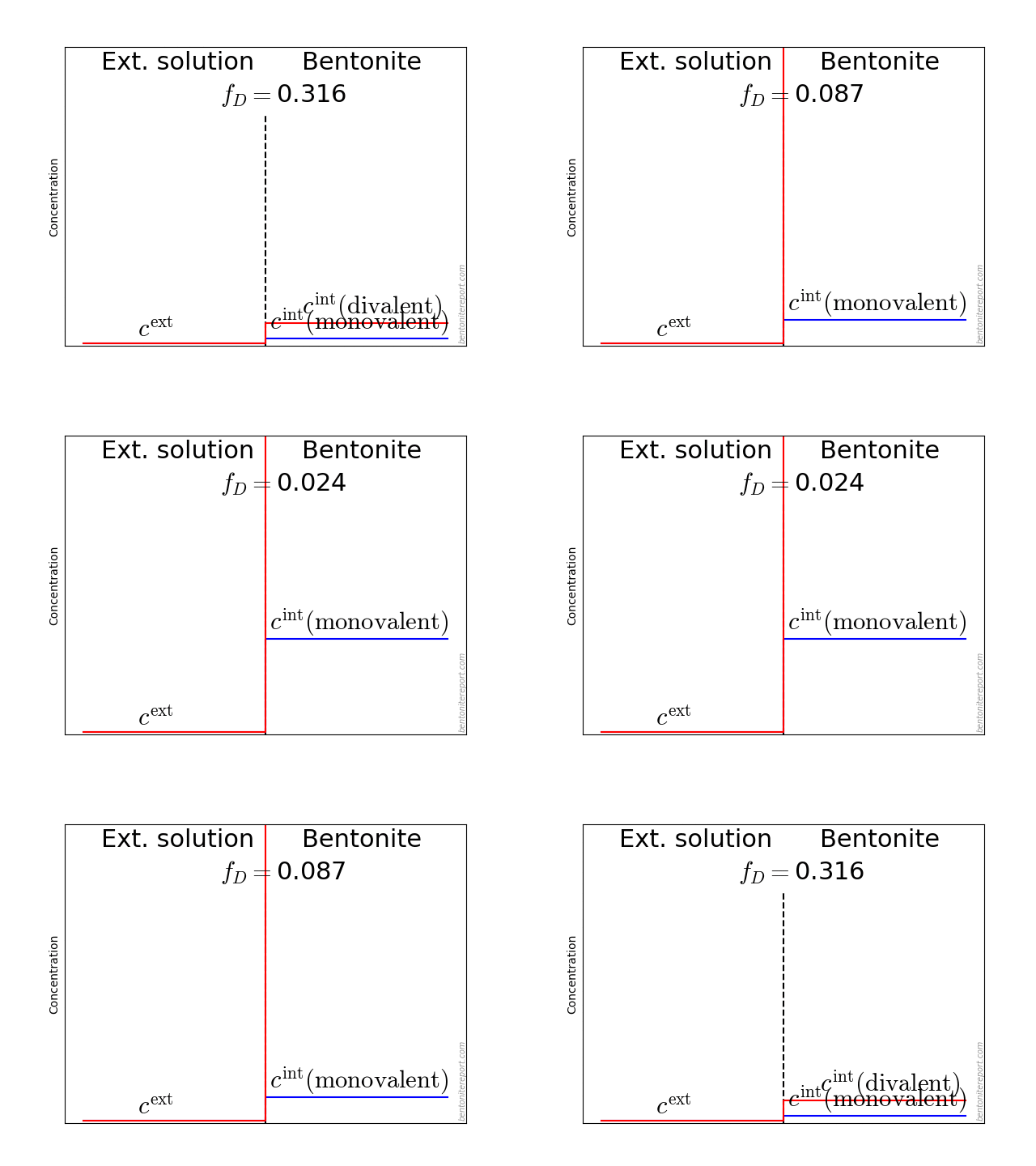
It may also be helpful to see the influence of \(f_D\) on the equilibrium. Since the Donnan potential is negative, \(f_D\) is less than unity and typical values in relevant bentonite systems is \(f_D \sim\) 0.01 — 0.4. Due to the exponent \(-z_i\) in eq. 2, this influence on the equilibrium looks quite different for species with different valency. For mono- and di-valent cations, the behavior looks like this (here is put \(\Gamma = 1\) for both species)

Variation of internal cation concentrations with varying Donnan factor

The typical behavior for cations is that the internal concentration is much larger than the corresponding external concentration (at \(f_D = 0.01\) in the above animation, the internal concentration for the di-valent cation is enhanced by a factor \(\Xi = 10 000\)!). For anions, the internal concentration is instead lower than the external concentration,2 as shown here (\(\Gamma = 1\) for both species)

Variation of internal anion concentration with the Donnan factor

Equation for \(f_D\)

For a complete description, we need an equation for calculating \(f_D\). This is derived by requiring charge neutrality in the two compartments and looks like

\begin{equation*} \sum_i z_i\cdot\Gamma_i \cdot c_i^\mathrm{ext} \cdot f_D^{-z_i} – c_{IL} = 0 \tag{3} \end{equation*}

where

\begin{equation*} c_{IL} = \frac{CEC}{F \cdot w} \end{equation*}

is the structural charge present in the clay (i.e. negative montmorillonite layer charge) expressed as a monovalent interlayer concentration. Here \(CEC\) is the cation exchange capacity of the clay component, \(w\) the water-to-solid mass ratio,3 and \(F\) is the Faraday constant.

The way eq. 3 is formulated implies that the external concentrations should be used as input to the calculation. This is typically the case as the external concentrations are under experimental control.

In typical geochemical systems it is required to account for aqueous species with valency at least in the range -2 — +2 (e.g. \(\mathrm{Ca}^{2+}\), \(\mathrm{Na}^{+}\), \(\mathrm{Cl}^{-}\), \(\mathrm{SO_4}^{2-}\)), which implies that the equation for calculating \(f_D\) is generally a polynomial equation of degree four or higher.

An important special case is the 1:1 system — e.g. pure Na-montmorillonite contacted with a NaCl solution — which has an equation for \(f_D\) of only degree two, and thus has a relatively simple analytical solution

\begin{equation*} f_D = \frac{c_{IL}}{2c^\mathrm{ext} \Gamma_\mathrm{Cl}} \left ( \sqrt{1+ \frac{4(c^\mathrm{ext})^2 \Gamma_\mathrm{Na}\Gamma_\mathrm{Cl}} {c_{IL}^2}} – 1 \right ) \end{equation*}

With the machinery in place for calculating the Donnan potential, here is an animation demonstrating the response in internal sodium and chloride concentrations as the external NaCl concentration is varied. In this calculation \(c_{IL} = 2\) M, and \(\Gamma_\mathrm{Na} = \Gamma_\mathrm{Cl} = 1\)

Relation between internal and external Na and Cl concentrations

Comment on through-diffusion

To me, the last illustration makes it absolutely clear that Donnan equilibrium and the homogeneous mixture model provide the correct principal explanation for e.g. the behavior of tracer ions in through-diffusion tests. If you choose to relate the flux in through-diffusion tests to the external concentration difference — which is basically done in all published studies, via the parameter \(D_e\) — you will evaluate large “diffusivities” for cations and small “diffusivities” for anions. These “diffusivities” will, moreover, have the opposite dependence on background concentration: the cation flux diverges in the low background concentration limit,4 while the anion flux approaches zero.

But this behavior is seen to be caused by differently induced internal concentration gradients. If fluxes are related to these gradients — which they of course should, if you strive for an actual Fickian description — you find that the diffusivities are no different from what is evaluated in closed-cell tests. Relating the steady-state flux to the external concentration difference in the homogeneous mixture model gives (assuming zero tracer concentration on the outflow side)

\begin{equation*} j_\mathrm{ss} = -\phi\cdot D_c \cdot \nabla c^\mathrm{int} = \phi\cdot D_c \cdot\Xi\cdot \frac{c^\mathrm{source}}{L} \end{equation*}

where \(c^\mathrm{source}\) denotes the tracer concentration in the external solution on the inflow side, \(\phi\) is the porosity, \(D_c\) is the pore diffusivity in the interlayer domain, and \(L\) is the length of the bentonite sample. From the above equation can directly be identified

\begin{equation} D_e = \phi\cdot\Xi\cdot D_c \end{equation}

\(D_e\) is thus not a diffusion coefficient, but basically a measure of \(\Xi\).

Note that this explanation for the behavior of \(D_e\) does not invoke any notion of an anion accessible volume, nor any “sorption” concept for cations.5

Additional comments

When I first published on Donnan equilibrium in bentonite, I was a bit confused and singled out the term “Donnan equilibrium” to refer to anions only, while calling the corresponding cation equilibrium “ion-exchange equilibrium”. To refer to “both” types of equilibrium we used the term “ion equilibrium”.6 Of course, Donnan equilibrium applies to ions of any charge and, being better informed, I should have used a more stringent terminology. In later publications I have tried to make amends by pointing out that the process of cation exchange is part of the establishment of Donnan equilibrium.

Being new to the Donnan equilibrium world, I also invented some of my own nomenclature and symbols: e.g. I named the ratio between internal and external concentration the ion equilibrium coefficient (\(\Xi\)). Conventionally, if I now have understood correctly, this concentration ratio is referred to as the “Donnan ratio”, and is usually labeled \(r\) (although I’ve also seen \(K\)).

But the term “Donnan ratio” seems to be used slightly differently in different contexts, e.g. defined either as \(c^\mathrm{int}/c^\mathrm{ext}\) or as \(c^\mathrm{ext}/c^\mathrm{int}\), and is sometimes related more directly to the Donnan potential (if no distinction is made between activities and concentrations, we can write \(f_D^{-z_i} = c_i^\mathrm{int}/c_i^\mathrm{ext}\)). I therefore will continue to use the term “ion equilibrium coefficient” — with label \(\Xi\) — in the context of bentonite systems. This usage has also been picked up in some other clay publications. The ion equilibrium coefficient should be understood as strictly defined as \(\Xi = c^\mathrm{int}/c^\mathrm{ext}\) for any species, and never to define, or being defined by, the Donnan potential.

To emphasize the difference between effects due to the presence of a Donnan potential and effects due to different local chemical environments, I will refer to \(f_D\) as the Donnan factor. (This term does not seem to be used conventionally for any other quantity, although there are examples where it is used as a synonym for Donnan ratio.)

Finally, as in any other approach, the current framework requires a description for the activity coefficients. For activity coefficients in the external solution, there are quite a number of models already available. For the interlayer, modeling — and measuring! — activities is an open research area (at least I hope that this research area is open).

Footnotes

[1] This is just one of several major “loose ends” in most multi-porous models. I have earlier discussed the lack of treatment of swelling, and the incorrect treatment of fluxes in different domains. Update (220622): The lack of a semi-permeable component in multi-porosity models is further discussed here.

[2] This does not have to be the case in principle, if \(\Gamma\) for the anion is large, at the same time as the external concentration is not too low.

[3] Hence, it is implied that we use concentration units based on water mass (molality).

[4] What actually happens is that the transport resistance in the filters begins to dominate.

[5] Speaking of “sorption”, we have noted before that this term nowadays is used to mean any type of uptake between bulk water and some other domain (where the species may or may not be immobile). In this sense, there is “sorption” in the homogeneous mixture model (for both cations and anions), but only at interfaces to external solutions. It thus translates to a boundary condition, rather than being part of the transport dynamics within the clay (which makes life much simpler from a numeric perspective). Update (220622): The homogeneous mixture model is extended to deal with ions that truly sorbs here.

[6] It turns out Donnan himself actually used this terminology (“ionic equilibria”)

Chloride content: UNKNOWN

Accurate experimental data is important for supporting bentonite model development. It both guides us when deciding what to include in a model and allows us to evaluate model performance. It is therefore distressing to note that the accumulated empirical data on “anion” exclusion gives a far from coherent picture. Let’s have a look.

Although the phenomenon being modeled often is referred to as anion exclusion, data mainly exists for chloride. We therefore restrict ourselves to look at reported equilibrium values for chloride1 in bentonite.

For an equilibrium value to be relevant, the sample in which it was measured must be specified, as well as the corresponding composition of the external solution. Published equilibrium values have almost exclusively been measured in samples of sodium dominated bentonite of various density — either purified Na-montmorillonite, or commercial products, in particular “MX-80”. We therefore further restrict ourselves to look at chloride equilibrium in sodium dominated bentonite. We also require that the external solutions contain a specified concentration of a pure sodium salt (in practice NaCl, NaClO4, or NaNO3).

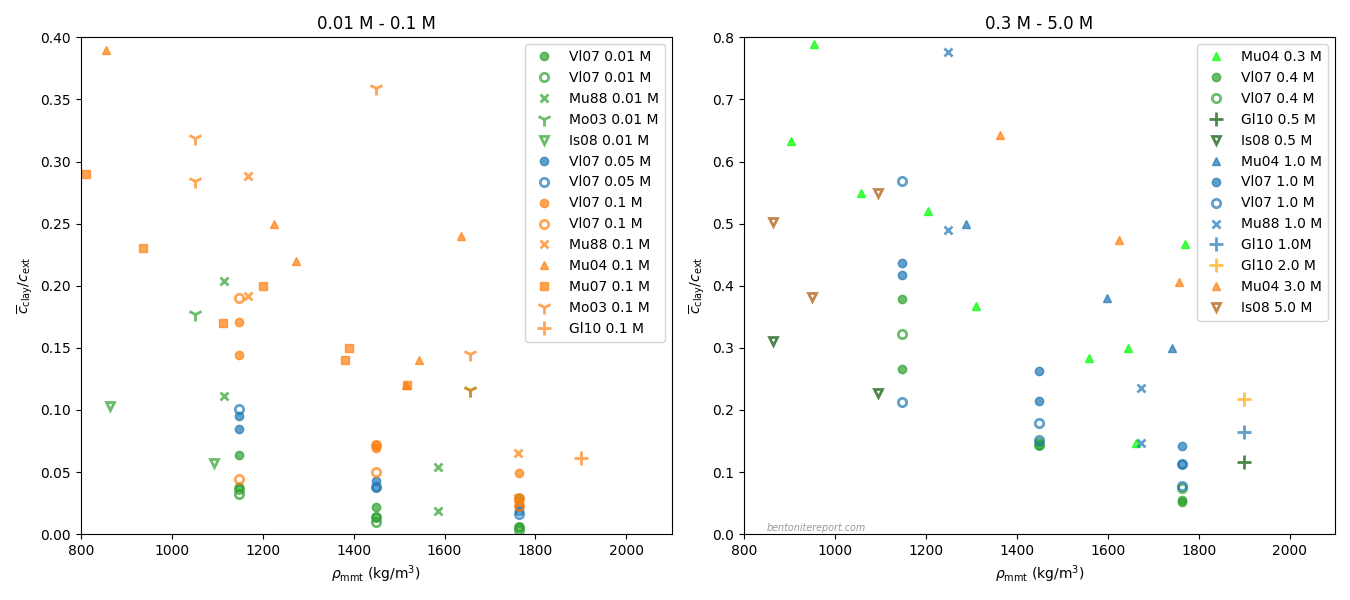
This figure summarizes basically all (as far as I’m aware) published data — subject to the requirements stated above — on equilibrium chloride content in compacted sodium bentonite (click on it for full size)

Basically all published Cl equilibruim data on sodium dominated bentonite
Data sources: Mu88, Mo03, Mu04, Mu07, Vl07, Is08, Gl10

The plots show sets of equilibrium chloride concentrations as a function of density, for constant external concentration. The equilibrium concentration is expressed in terms of the “exclusion variable” \(\bar{c}_\mathrm{clay}/c_\mathrm{ext}\), where \(\bar{c}_\mathrm{clay}\) is the average chloride concentration in the clay (i.e. total amount of chloride divided by the amount of water), and \(c_\mathrm{ext}\) is the corresponding concentration in external solution. For relevant comparison between systems with different montmorillonite mass fraction, we adopt the “effective montmorillonite dry density”.2

\begin{equation} \rho_\mathrm{mmt} = \frac{ \rho_\mathrm{d}\cdot x} {1-\frac{\rho_\mathrm{d}}{\rho_\mathrm{s}}\left (1-x \right )} \end{equation}

where \(x\) denotes the montmorillonite mass fraction, \(\rho_\mathrm{d}\) is the sample dry density, and \(\rho_\mathrm{s}\) is the solid grain density of the accessory minerals.3

The left diagram shows measurements done with background concentration 0.1 M or lower, and the right diagram shows measurements with background concentration 0.3 M or higher. The data within each diagram is color coded: background concentration increases in the order green \(\rightarrow\) blue \(\rightarrow\) orange. Series with filled markers correspond to actual equilibrium tests, while the others show equilibrium concentrations inferred from through-diffusion tests.

We don’t have to examine the above plot in any great detail to conclude that existing “anion” exclusion data is quite heavily scattered. By squinting the eyes, and without assessing the reasonableness of individual data points, the graphs basically say that, for e.g. density ~1200 kg/m3, chloride exclusion is determined only within the range 0.05 — 0.3 at 0.1 M, and the range 0.2 — 0.8 at 1.0 M.4

The overall scattering is so large that it is doubtful if the data supports any of the models that has been suggested for anion exclusion in compacted bentonite. To my knowledge, any such model complies with the following “truths”

  1. Exclusion increases with increasing density at constant background concentration
  2. Exclusion decreases with increasing background concentration at constant density

Taking the above data at face value, it is probably fair to say that it supports the first of these statements. But although it complies with this qualitative statement, it is hard to see how a more quantitative description — i.e. an expression describing how chloride exclusion decreases with density — could be extracted from the data.

The second “truth” is not even qualitatively supported by the data. Although a relatively clear trend of decreasing exclusion with increasing background concentration can be spotted at low concentrations, the data points for higher concentrations are relatively well scrambled.

In my head it is quite clear that the problem here is the experimental data (viewed in aggregation), rather than the truth-values of the statements listed above. To better understand the source for the scatter, I therefore think each underlying study should be reviewed and assessed. Apart from reasonably being of varying quality, there are a number of factors that potentially could contribute to the noise, e.g. differences in sample materials (purified montmorillonite or “raw” bentontie), and test principles (actual equilibrium tests or through-diffusion tests).

In future blog posts I intend to perform these reviews of the involved studies. Faced with the plots above, I think this may be a more fruitful activity than to just switch to log axes and continue with modeling.

Footnotes

[1] There is also some systematic iodide data, which I may take a look at in a future blog post.

[2] This variable is known under many names, e.g. “montmorillonite density”, “partial dry density”, “effective clay dry density”, or “effective dry bulk density of the clay matrix”.

[3] I have assumed \(\rho_\mathrm{s}\) = 2750 kg/m3, the same value I usually adopt for the grain density of “Wyoming” type montmorillonite.

[4] These are intervals for the actual measurements. An appropriate confidence interval is even larger than this.

Sorption part III: Donnan equilibrium in compacted bentonite

Consider this basic experiment: contact a water saturated sample of compacted pure Na-montmorillonite, with dry mass 10 g and cation exchange capacity 1 meq/g, with an external solution of 100 ml 0.1 M KCl. Although such an experiment has never been reported1, I’m convinced that all agree that the outcome would be similar to what is illustrated in this animation.

Hypothetical ion equilibrium test

Potassium diffuses in, and sodium diffuses out of the sample until equilibrium is established. At equilibrium also a minor amount of chloride is found in the sample. The indicated concentration levels are chosen to correspond roughly to results from from similar type of experiments.2

Although results like these are quite unambiguous, the way they are described and modeled in the bentonite3 literature is, in my opinion, quite a mess. You may find one or several of the following terms used to describe the processes

  • Cation exchange
  • Sorption/Desorptioṇ
  • Anion exclusion
  • Accessible porosity
  • Surface complexation
  • Donnan equilibrium
  • Donnan exclusion
  • Donnan porosity/volume
  • Stern layer
  • Electric double layer
  • Diffuse double layer
  • Triple layer
  • Poisson-Boltzmann
  • Gouy-Chapman
  • Ion equilibrium

In this blog post I argue for that the primary mechanism at play is Donnan equilibrium, and that most of the above terms can be interpreted in terms of this type of equilibrium, while some of the others do not apply.

Donnan equilibrium: effect vs. model

In the bentonite literature, the term “Donnan” is quite heavily associated with the modeling of anion equilibrium; e.g. the term “Donnan exclusion” is quite common , and you may find statements that researchers use “Donnan porespace models” as models for “anion exclusion”, or a “Donnan approach” to model “anion porosity”.4 Sometimes the term “Donnan effect” is used synonymously with “Salt exclusion”. Also when authors acknowledge cations as being part of “Donnan” equilibrium, the term is still used mainly to label a model or an “approach”.

But I would like to push for that “Donnan equilibrium” primarily should be the name of an observable effect, and that it applies equally to both anions and cations. This effect — which was hypothesized by Gibbs already in the 1870s — relies basically only on two things:

  • An electrolytic system, i.e. the presence of charged aqueous species (ions).
  • The presence of a semi-permeable component that is permeable to some of the charges, but does not allow for the passage of at least one type of charge.

In equilibrated systems fulfilling these requirements it is — to use Donnan’s own words — “thermodynamically necessary” that the permeant ions distribute unequally across the semi-permeable component. This phenomenon — unequal ion distributions on the different sides of the semi-permeable component — should, in my opinion, be the central meaning of the term “Donnan equilibrium”.

The first publication of Donnan on the effect actually concerned osmotic pressure response, in systems of Congo Red separated from solutions of sodium chloride and sodium hydroxide. The same year (1911) he also published the ionic equilibrium equations for some specific systems.5 In particular he considered the equilibrium of NaCl initially separated from NaR, where R is an impermeant anion (e.g. that of Congo Red), leading to the famous relation (“int” denotes the solution containing R)

\begin{equation} c_\mathrm{Na^+}^\mathrm{ext}\cdot c_\mathrm{Cl^-}^\mathrm{ext} = c_\mathrm{Na^+}^\mathrm{int}\cdot c_\mathrm{Cl^-}^\mathrm{int} \tag{1} \end{equation}

Unfortunately, this relation alone (or relations derived from it) is often what the term “Donnan” is associated with in today’s clay research literature, with the implication that systems not obeying it are not Donnan systems. But the above relation assumes ideal conditions and complete ionization of the salts — issues Donnan persistently seems to have grappled with. In a review on the effect he writes

The exact equations can, however, be stated only in terms of the chemical potentials of Willard Gibbs, or of the ion activities or ionic activity-coefficients of G. N. Lewis. Indeed an accurate experimental study of the equilibria produced by ionically semi-permeable membranes may prove to be of value in the investigation of ionic activity coefficients.

It must therefore be understood that, if in the following pages ionic concentrations and not ionic activities are used, this is done in order to present a simple, though only approximate, statement of the fundamental relationships.

The issue of (the degree of) ionization was explicitly addressed in publications following the 1911 article; Donnan & Allmand (1914) motivated their investigations of the \(\mathrm{KCl/K_4Fe(CN)_6}\) system by that “it was deemed advisable to test the relation when using a better defined, non-dialysable anion than that of Congo-red”, and the study of the Na/K equilibrium in Donnan & Garner (1919) used ferrocyanide solutions on both sides of the membrane in an attempt to overcome the difficulty of the “uncertainty as to the manner of ionisation of potassium ferrocyanide” (and thus for the simplified equations to apply).

I mean that since non-ideality and ion association are general issues when treating salt solutions, it does not make much sense to use the term “Donnan equilibrium” only when some particular equation applies; as long as the mechanism for the observed behavior is that some charges diffuse through a semi-permeable component, while some others don’t, the effect should be termed Donnan equilibrium.

Donnan equilibrium in gels, soils and clays

After Donnan’s original publications in 1911, the effect was soon recognized in colloidal systems. Procter & Wilson (1916) used Donnan’s equations to analyze the swelling of gelatin jelly immersed in hydrochloric acid. In this case chloride is the charge compensating ion, allowed to move between the phases, while the immobile charge is positive charges on the gelatin network. Thus, no semi-permeable membrane is necessary for the effect; alternatively one could say that the gel constitutes its own semi-permeable component. The Donnan equilibrium in protein solutions was further and extensively investigated by Loeb.

As far as I am aware, Mattson was first to identify the Donnan effect in “soil” suspensions,6 attributing e.g. “negative adsorption” of chloride as a consequence of Donnan equilibrium, and explicitly referencing the works of Procter and Loeb. Mattson describes the suspension in terms of electric double layers with a diffuse “atmosphere of cations” surrounding the “micelle” (the soil particle), and refers to Donnan equilibrium as the distribution of an electrolyte between the “micellar” and the “inter-micellar” solutions. Oddly,7 he uses Donnan’s original framework (e.g. eq. 1) to quantify the equilibrium, although the electrostatic potential and the ion concentrations varies significantly in the investigated systems. A more appropriate treatment would thus be to use e.g. the Gouy-Chapman description for the ion distribution near a charged plane surface (which he refers to!).

Instead, Schofield (1947) analyzed Mattson’s data using this approach. He also comments on its (the Gouy-Chapman model) range of validity

… [T]he equation is applicable to cases in which the distance between opposing surfaces considerably exceeds the distance between neighboring point charges on the surfaces; for there will then be a range of electrolyte concentrations over which the radius of the ionic atmosphere is less than the former and greater than the latter. In Mattson’s measurements on bentonite suspension, these distances are roughly 500 A. and 10 A. respectively, so there is an ample margin.

He continues to comment on the validity of Donnan’s original equations

When the distance ratio has narrowed to unity, it is to be expected that the system will conform to the equation of the Donnan membrane equilibrium. This equation fits closely the measurements of Procter on gelatine swollen in dilute hydrochloric acid. […] In a bentonite suspension the charges are so far from being evenly distributed that the Donnan equation is not even approximately obeyed.

From these statements it should be clear that the general behavior (cation exchange, salt exclusion) of ions in bentonite equilibrated with an external solution is due to the Donnan effect.8 The appropriate theoretical treatment of this effect differs, however, depending on details of the investigated system. To argue whether or not e.g. the Gouy-Chapman description should be classified as a “Donnan” approach is purely semantic.

It is also clear that in the case of compacted bentonite the distance ratio is narrowed to unity — the typical interlayer distance is 1 nm, which also is the typical distance between structural charges in the montmorillonite particles. It is thus expected that Donnan’s original treatment may work for such systems (adjusted for non-ideality), while the Gouy-Chapman description is not valid.9

The message I am trying to convey is neatly presented in Overbeek (1956) — a text I highly recommend for further information. Overbeek distinguishes between “classical” (Donnan’s original) and “new” (accounting for variations in potential etc.) treatments of Donnan equilibrium, and says the following about dense systems

If the particles come very close together the potential drop between [surface and interlayer midpoint] becomes smaller and smaller as illustrated in Fig. 4. This means that the local concentrations of ions are not very variable and that we are again back at the classical Donnan situation, where distribution of ions, osmotic pressure and Donnan potential are simply given by the elementary equations as treated in section 2. It is remarkable that the new treatment of the Donnan effects may deviate strongly from the classical treatment when the colloid concentration is low, but not when it is high.

It thus seems plausible that Donnan equilibrium in compacted bentonite can be treated using Donnan’s original equations. But — as interlayer pores are a quite extreme chemical environment — substantial non-ideal behavior may be expected. Treating such behavior is a large challenge for chemical modeling of compacted bentonite, but can not be avoided, since interlayers dominate the pore structure.

Cation exchange is Donnan equilibration

The term “Donnan” in modern bentonite literature is, as mentioned, quite heavily associated with the fate of anions interacting with bentonite. In contrast, cations are often described as being “sorbed” onto the “solids”. This sorption is usually separated into two categories: cation exchange and surface complexation.

Surface complexation reactions are typically described using “surface sites”, and are usually written something like this (exemplified with sodium sorption)

\begin{equation} \equiv \mathrm{S^-} + \mathrm{Na^{+}(aq)} \leftrightarrow \equiv \mathrm{SNa} \end{equation}

where the “surface site” is labeled \(\equiv \mathrm{S}^-\)

Cation exchange is also typically written in terms of “sites”, but requires the exchange of ions (duh!), like this (here exemplified for calcium/sodium exchange)

\begin{equation} \mathrm{2XNa} + \mathrm{Ca^{2+}(aq)} \leftrightarrow \mathrm{X_2Ca} + 2\mathrm{Na^+(aq)} \tag{2} \end{equation}

where X represents an “exchange site” in the solid phase.

In the clay literature the distinction between “surface complexation” and “ion exchange” reactions is rather blurred. You can e.g. find statements that “the ion exchange model can be seen as a limiting case of the surface complex model…”, and it is not uncommon that ion exchange is modeled by means of a surface complexation model. It also seems rather common that ion exchange is understood to involve surface complexation.

Underlying these modeling approaches and descriptions is the (sometimes implicit) idea that exchanged ions are immobile, which clearly has motivated e.g. the traditional diffusion-sorption model for bentonite and claystone. This model assumes that ion exchange binds cations to the solid, making them immobile, while diffusion occurs solely in a bulk water phase (which, incredibly, is assumed to fill the entire pore volume).

However, the idea that the exchanged ion is immobile does not agree with descriptions in the more general ion exchange literature, which instead acknowledge the process as an aspect of the Donnan effect.

Indeed, already in 1919, Donnan & Garner reported Na/K exchange equilibrium in a system consisting of two ferrocyanide solutions separated by a membrane impermeable to ferrocyanide, and it is fully clear that the particular distribution of cations in such systems is just as “thermodynamically necessary” as the distribution of chloride in the initial work on Congo Red and ferrocyanide.

Applied to clays, it is clear that cation exchange occurs even without postulating specific “sorption sites” or immobilization. On the contrary, ion exchange occurs in Donnan systems precisely because the ions are mobile.

In his book “Ion exchange”,10 Freidrich Helfferich describes ion exchange as diffusion, and distinguishes it from “chemical” processes

Occasionally, ion exchange has been referred to as a “chemical” process, in contrast to adsorption as a “physical” process. This distinction, though plausible at first glance, is misleading. Usually, in ion exchange as a redistribution of ions by diffusion, chemical factors are less significant than in adsorption where the solute is held by the sorbent by forces which may not be purely electrostatic.

Furthermore, in describing a general ion exchange system, he states the exact characteristics of a Donnan system, with the crucial point that the exchangeable ion is “free”, albeit subject to the constraint of electroneutrality

Ion exchangers owe their characteristic properties to a peculiar feature of their structure. They consist of a framework which is held together by chemical bonds or lattice energy. This framework carries a positive or negative electric surplus charge which is compensated by ions of opposite sign, the so-called counter ions. The counter ions are free to move within the framework and can be replaced by other ions of the same sign. The framework of a cation exchanger may be regarded as a macromolecular or crystalline polyanion, that of an anion exchanger as a polycation.

To give a very simple picture, the ion exchanger may be compared to a sponge with counter ions floating in the pores. When the sponge is immersed in a solution, the counter ions can leave the pores and float out. However, electroneutrality must be preserved, i.e., the electric surplus charge of the sponge must be compensated at any time by a stoichiometrically equivalent number of counter ions within the pores. Hence a counter ion can leave the sponge only when, simultaneously, another counter ion enters and takes over the task of contributing its share to the compensation of the framework charge.

With this “sponge” model at hand, he argues for that the reaction presented in eq. 2 above should be reformulated

[T]he model shows that ion exchange is essentially a statistical redistribution of counter ions between the pore liquid and the external solution, a process in which neither the framework nor the co-ions take part. Therefore Eqs. (1-1) [eq. 2 above] and (1-2) should be rewritten: \begin{equation} 2\overline{\mathrm{Na^+}} + \mathrm{Ca^{2+}} \leftrightarrow \overline{\mathrm{Ca^{2+}}} + 2\mathrm{Na^{+}} \end{equation} \begin{equation} 2\overline{\mathrm{Cl^-}} + \mathrm{SO_4^{2+}} \leftrightarrow \overline{\mathrm{SO_4^{2-}}} + 2\mathrm{Cl^{-}} \end{equation} Quantities with bars refer to the inside of the ion exchanger.

This “statistical redistribution” is of course nothing but the establishment of Donnan equilibrium between the external solution and the exchanger phase (as in the animation above). Naturally, Donnan equilibrium — using either the “classical” or the “new” equations — is at the heart of many analyses of ion exchange systems.

Unfortunately, this has not been the tradition in the compacted bentonite research field, where a “diffuse layer” approach to cation exchange has only been considered in more recent years, and then usually as a supplement to already existing models and tools. We are therefore in the rather uneasy situation that ion exchange in bentonite nowadays often is explained in terms of both a Donnan effect and as specific surface complexation.

Considering the robust evidence for significant ion mobility in interlayer pores, I strongly doubt surface complexation to be relevant for describing ion exchange in bentonite.11 Instead, I believe that not separating these processes obscures the analysis of species that actually do sorb in these systems. In any event, the exact effects of Donnan equilibrium — a mechanism dependent on nothing but that some charges diffuses through the semi-permeable component, while some others don’t — must first and foremost be worked out.

A demonstration of compacted bentonite as a Donnan system

To demonstrate how well the Donnan effect in compacted bentonite is captured by Donnan’s original description, we use the following relation, derived from eq. 1 (i.e we assume only the presence of a 1:1 salt, apart from the impermeable component)

\begin{equation} \frac{c_\mathrm{Cl^-}^\mathrm{int}}{c_\mathrm{Cl^-}^\mathrm{ext}} = -\frac{1}{2}\frac{z}{c_\mathrm{Cl^-}^\mathrm{ext}} + \sqrt{\frac{1}{4} (\frac{z}{c_\mathrm{Cl^-}^\mathrm{ext}})^2+1} \tag{3} \end{equation}

Here \(z\) denotes the concentration of cations compensating impermeable charge. Eq. 3 quantifies anion exclusion, and is seen to depend only on the ratio \(c_\mathrm{Cl^-}^\mathrm{ext}/z\).

This equation is plotted in the diagram below, together with data of chloride exclusion in sodium dominated bentonite (Van Loon et al., 2007) and in potassium ferrocyanide (Donnan & Allmand, 1914)

Anion exclusion in bentonite and ferrocyanide compared with Donnan's ideal formula

I find this plot amazing. Although some points refer to bentonite at density 1900 \(\mathrm{kg/m^3}\) (corresponding to \(z \approx 5\) M), while others refer to a solution of approximately 25 mM \(\mathrm{K_4Fe(CN)_6}\) (\(z \approx 0.1\) M), the anion exclusion behavior is basically identical! Moreover, it fits the ideal “Donnan model” (eq. 3) quite well!

There is of course a lot more to be said about the detailed behavior of these systems, but I think a few things stand out:

  • It should be obvious that the basic mechanism for anion exclusion is the same in these two systems. This observed similarity thus invalidates the idea that anion exclusion in compacted bentonite is due to an intricate, ionic strength-dependent partitioning of a complex pore structure into parts which either are, or are not, accessible to chloride. In other words, the above plot is another demonstration that the concept of “accessible anion porosity” is nonsense.
  • The similarity between compacted bentonite and the simpler ferrocyanide system confirms Overbeek’s statement above, that Donnan’s “elementary” equations apply when the colloid concentration (i.e. density) is high enough.
  • The slope of the curve at small external concentrations directly reflects the amount of exchangeable cations that contributes to the Donnan effect. The similarity between model and experimental data thus confirms that the major part of the cations are mobile, i.e. not adsorbed by surface complexation. The similarity between the bentonite system and the ferrocyanide system also suggests that non-ideal corrections to the theory is better dealt with by means of e.g. activity coefficients, rather than by singling out a quite different mechanism (surface complexation) in one of the systems.

Footnotes

[1] The only equilibrium study of this kind I am aware of, that involves compacted, purified, homo-ionic clay, is Karnland et al. (2011). This study concerns Na/Ca exchange, and does not investigate the associated chloride equilibrium.

[2] I have assumed a K/Na selectivity coefficient of 2, and 95% salt exclusion.

[3] “Bentonite” is used in the following as an abbreviation for bentonite and claystone, or any clay system with significant cation exchange capacity.

[4] This particular publication states that I am one of the researchers using a “Donnan approach” to model “anion porosity”. Let me state for the record that I never have modeled “anion porosity”, or have any intentions to do so.

[5] This article has an English translation.

[6] In my head, a “soil suspension” and a “soil particle” are not very well defined entities. As I understand, Mattson investigated “Sharkey soil” and “Bentonite”. Sharkey soil is reported to have a cation exchange capacity of around 0.3 eq/kg, and the bentonite appear to be of “Wyoming” type. It is thus reasonably clear that Mattson’s “soil” particles are montmorillonite particles.

[7] Mattson and co-workers published a whole series of papers on “The laws of soil colloidal behavior” during the course of over 15 years, and appear to have caused both awe and confusion in the soil science community. I find it a bit amusing that there is a published paper (Kelley, 1943) which in turn reviews and comments on Mattson’s papers. Some statements in this paper include: “It seems to be generally agreed that some of [Mattsons papers] are difficult to understand.” and “The extensive use by [Mattson and co-workers] of terms either coined by them or used in new settings, the frequent contradictions of statement and inconsistencies in definition, and perhaps most important of all, the use by the authors of theoretical reasoning founded, not on experimentally determined data, but on calculations based on purely hypothetical premises, make it difficult to condense these papers into a form suitable for publication without doing injustice to the authors or sacrificing strict accuracy.

[8] It may be worth noting that the only works referenced by Schofield — apart from a paper on dye adsorption — are Mattson, Procter and Donnan. Remarkably, Gouy is not referenced!

[9] Of course, one can instead solve the Poisson-Boltzmann equation for “overlapping” double layers.

[10] In its introduction is found the following gem: “A spectacular evolution began in 1935 with the discovery by two English chemists, Adams and Holmes, that crushed phonograph records exhibit ion-exchange properties.” Who wouldn’t want to hear more of that story?!

[11] As a further argument for that the concept of immobile exchangeable ions in bentonite is flawed, one can take a look at the spread in reported values for the fraction of such ions. You can basically find any value between \(>99\%\) and \(\sim 0\%\) for the same type of systems. To me, this indicates overparameterization rather than physical significance.

Anion-accessible porosity – a brief history

Genesis

In the beginning there was the Poisson-Boltzmann equation. Solving it for the case of a salt solution in contact with a negatively charged plane surface (a.k.a. the Gouy-Chapman model) gives the concentration of cations and anions in the solution as a function of the distance to the surface, like this1

Illustration of Gouy-Chapman concentration profiles

Note:

  1. The suppression of the anion concentration near the surface is often referred to as negative adsorption or anion exclusion. The total amount of excluded anions per unit surface area (indicated in green), usually labeled \(\Gamma^-\), is obtained by integrating the Poisson-Boltzmann equation.
  2. There are, nevertheless, anions everywhere! This model will give zero anion concentration only for an infinitely negative electrostatic potential (or if \(c_0 = 0\), of course).

A clever way to utilize negative adsorption is for estimating the amount of smectite surface area in a soil sample, first suggested by Schofield (1947). This is done by comparing measured values of negative adsorption with the appropriate expression evaluated from the Gouy-Chapman model. When doing the necessary math2 for such an analysis you naturally end up with expressions like

\begin{equation} \frac{\Gamma^-}{c_0} \sim \text{const.}\cdot \kappa^{-1} \tag{1} \end{equation}

where \(c_0\) is the external anion concentration (i.e. far from the surface), and \(\kappa^{-1}\) is the Debye length. This equation, having the dimension of length, can be interpreted as the width, \(d_{ex}\), of a region devoid of anions, which gives the same amount of negative adsorption as the full exclusion region, as illustrated here (yellow)

Illustration exclusion distance

However, note:

  1. This is just an equivalent, fictitious region.
  2. Anions are still everywhere!

Due to its convenience in the analysis, the notion of an equivalent region devoid of anions — often referred to in terms of “volume of exclusion” — became rather popular. At the same time, authors stopped emphasizing that this is a fictitious region. A clear example of such a transition is Edwards and Quirk (1962) who states that \(\Gamma^-/c_0\) “can be regarded as the surface depth from which chloride ions are excluded”, while in Edwards et al. (1965) the same quantity (multiplied by area) is referred to as “the volume from which chloride is excluded”. The latter statement is, strictly speaking, wrong: the actual volume from which anions are excluded is the entire region where the concentration deviates from \(c_0\), and the exclusion is only partial — there are anions everywhere!

Compacted bentonite

But the idea of an actual region devoid of anions seems to have stuck, and I believe that this influenced the interpretation of diffusion in compacted bentonite3 in terms of “effective porosity” or “anion accessible-porosity”. Concepts which, in turn, have motivated the idea that bentonite contains bulk water (“free water”, “pore water”).

The first example of this usage in studies of compacted bentonite, that I know of, is in Muurinen et al. (1988) reporting chloride through-diffusion in bentonite with various densities and background concentrations.

The tracer concentration of the porewater clearly depends on the compaction of bentonite and on the salt concentration of the circulating water. The effective porosity can even be less than one percent when the salt concentration is low and compaction high. Also, the diffusivities strongly depend on the density of bentonite and on the salt concentration.

The low tracer concentration in bentonite in the diffusion tests […] are indicative of ion-exclusion [5]. Ion-exclusion probably decreases the effective size of the pores, which changes the geometric factor, of bentonite and thus the apparent diffusivity. In addition to the geometric factor, the effective diffusivity takes into account the effective pore volume; thus, the dependence is even stronger.

“Effective porosity” has not been defined earlier in the article, so it is difficult to know precisely what the authors mean by the term. But it is relatively clear4 from the second paragraph that they explain the measured fluxes as being a result of a physical variation of the pore volume accessible to anions, rather than as a variation of the tracer concentration in a homogeneous system. This is also supported by their writing in the conclusions section: “The decreased pore size and porosity caused by ion-exclusion could at least qualitatively explain the dependence.”

However, the reference they provide (“[5]”) is Soudek et al. (1984), who calculate anion exclusion by means of — the Poisson-Boltzmann equation! (Which predicts anions everywhere.) In fact, Soudek et al. (1984) calculate what they term “Donnan exclusion” in a homogeneous model of “parallel, equally-spaced platelets”. Thus, the reference supplied by Muurinen et al. (1988) is in direct contradiction with their interpretation that the pore size and porosity is decreasing with the salt concentration.

Soudek et al. (1984) even provide an example of how the average chloride concentration between the platelets depends on the separation distance, when in equilibrium with an external solution of 10 mM, and write

Note the extremely strong rejection of the co-ion. At 50 w% clay (\(\sim 25\)Å plate separation) almost 90% of the anions are rejected.

which is completely in line with the observation of Muurinen et al. (1988) that “The effective porosity can even be less than one percent when the salt concentration is low and compaction high”, if only “effective porosity” is replaced by “concentration between the plates”.

It makes me a bit tired to discover that the record could have been set straight over 30 years ago regarding which pores anions can access. Instead the bentonite research community, for the most part, doubled down on the idea that anions only have accesses to parts of the pore volume, or that compacted bentonite contains a significant amount of bulk water.

An explicit description of interpreting “chloride through diffusion porosity” as a specific, limited part of the pore volume is given by Bradbury and Baeyens (2003)

In the interlayer spaces and regions where the individual montmorillonite stacks are in close proximity, double layer overlap will occur and anion exclusion effects will take place. Exclusion will probably be so large that it is highly unlikely that anions can move through these regions (Bolt and de Haan, 1982). However, Cl anions do move relatively readily through compacted bentonite since diffusion rates have been measured in ‘‘through-diffusion’’ tests […]

If the Cl anions cannot move through the interlayer and overlapping double layer regions because of anion exclusion effects, then it is reasonable to propose that the ‘‘free water’’ must provide the diffusion pathways (Fig. 1). Therefore, the hypothesis is that the pore volume associated with the transport of chloride (and other anions) is the ‘‘free water’’ volume, and that this is the porewater in a compacted bentonite.

Here they refer to Bolt and De Haan, (1982) 5, when arguing for that anions do not have access to interlayers. But the analysis in this reference is based on nothing but — the Poisson-Boltzmann equation! (which predicts anions everywhere)

Another thing to note is the notion of “overlapping” diffuse layers. Studies of negative adsorption to quantify surface area typically look at soil suspensions, with a solid part of a few percent. In such systems it is justified to perform the analysis on a single diffuse layer because the distance between separate montmorillonite particles is large enough. But at higher density there is not enough space between separate clay particles for the ion concentrations to ever reach the “external” value (\(c_0\)) — the diffuse layers “overlap”.6

It has been shown that effects of “overlapping” diffuse layers on the resulting negative adsorption is significant already at a a solid content of 6%. When carrying over the anion exclusion analysis to compacted bentonite — with solid content typically above 70%! — it therefore becomes near impossible to believe that the system should contain regions unaffected by the montmorillonite (“free water”). Yet, the argumentation above, apart from being flawed in the way it refers to the Poisson-Boltzmann equation, relies critically on the existence of such regions.

The mindful reader may remark that compacted bentonite, if it mainly contains “overlapping” diffuse layers, perhaps is devoid of anions after all. But the Poisson-Boltzmann equation predicts anions everywhere also for “overlapping” diffuse layers. Actually, the model by Soudek et al. (1984), discussed above, considers this case.

Despite the improbability that montmorillonite particles in compacted bentonite can be spaced so far apart as to allow for bulk water within the system, the idea of anions only having access to “free” water was nevertheless further pursued by Van Loon et al. (2007). They provide a picture similar to this

Stack in Van Loon et al. 2007

The idea here (and elsewhere) is that bentonite consists of “stacks” of individual montmorillonite particles (TOT-layers) interlaced with interlayer water.7 The space between “stacks” is assumed large enough for diffuse layers to fully develop, and to merge into a bulk solution (“free water”), whose volume depends on the ionic strength, reminiscent of the excluded volume in eq 1.8 Anions are postulated to only have access to this “free” water.

But as references for anion exclusion is once again simply given studies based on the Poisson-Boltzmann equation (in particular, Bolt and De Haan, (1982)). But these — as I hope has been made clear by now — predict anions everywhere, and consequently do not support the suggested model. In this case, the mismatch between model and supporting references stands out, as the term “effective porosity” is used interchangeably with the term “Cl-accessible porosity”; if Gouy-Chapman theory in a convoluted way can be used to define an “effective” porosity (having no other meaning than a fictitious, equivalent volume), there is no possibility whatsoever to use it to support the idea of anions having access to only parts of the pore space. Ironically, “anion-accessible porosity” seems to be the most popular term nowadays for describing effects of anion exclusion in compacted bentonite.

The strongest confirmation that the modern-day concept of anion-accessible porosity is simply a misuse of the exclusion-volume concept is given in Tournassat and Appelo (2011). They provide a quite extensive background for the type of anion exclusion they consider, and it is based on the excluded-volume concept discussed above. They even explicitly calculate the excluded-volume (named “total chloride exclusion distance”) only to directly discard it as not suitable

However, this binary representation (absence or presence of chloride, Fig. 3) is not very representative of the system since the EDL is not completely devoid of anions.

Yet, after making this statement that anions are everywhere (in the diffuse layer) they anyway define anion accessible porosity as an effective, fictitious volume!9

Interlayers

Apart from treating the diffuse layer incorrectly, Bradbury and Baeyens (2003), Van Loon et al. (2007) and Tournassat and Appelo (2011) all make the additional unjustified assumption that interlayers — which in these studies are defined as distinctly different from diffuse layers10 — are completely devoid of anions. Bradbury and Bans (2003) cites conventional Poisson-Boltzmann based studies to incorrectly support this claim (see above). Also Van Loon et al. (2007) use Bolt and De Haan, (1982) as a reference11

Due to the very narrow space, the double layers in the interlayers overlap and the electric potential in the truncated layer becomes large leading to a complete exclusion of anions from the interlayer (Bolt and de Haan, 1982; Pusch et al., 1990; Olin, 1994; Wersin et al., 2004). The interlayer water thus contains exclusively cations that compensate the permanent charges located in the octahedral layer of the clay.

Of the other sources cited, Pusch et al. (1990) mention “Donnan exclusion” as the reason preventing anions from having access to interlayers. But this is incorrect – Donnan equilibrium always gives a non-zero anion concentration in the interlayer (as long as the external concentration is non-zero). Wersin et al. (2004) only claim that anions are “excluded” from interlayers, without further explanation or references. (I haven’t managed to read Olin (1994) .)

Tournassat and Appelo (2011) cites Bourg et al. (2003) to support the claim that anions have no access to interlayers

When the dry density is above \(1.8 \;\mathrm{kg/dm^3}\), almost all the porosity resides in the interlayers of Na-montmorillonite. Since anions are excluded from the interlayers, the anion-accessible porosity becomes zero, and anion-diffusion is minimal (Bourg et al., 2003)

But in Bourg et al. (2003) is explicitly stated that anion exclusion from interlayers is only “partial”!

To sum up…

The idea that anions have access only to parts of the pore volume is widespread in today’s compacted bentonite research community. In this blog post I have shown that this idea emerges from misusing the concept of exclusion-volume, and that all references used to support ideas of “complete exclusion” rests on the Poisson-Boltzmann equation. The Poisson-Boltzmann equation, however, predicts anions everywhere! Thus, the concept of an anion-accessible porosity, and the related idea that compacted bentonite contains different “types” of water, have not been provided with any kind of theoretical support.

In contrast, the result that anions have access to the entire pore volume is further supported both by molecular dynamics simulations, as well as by the empirical evidence for salt in interlayers.

Footnotes

[1] This figure is just an illustration, not an actual result. Update (220831): Actual solutions to the Poisson-Boltzmann equation are presented here.

[2] Schofield writes with an enthusiasm seldom seen in modern scientific papers: “I considered that it would be possible to compute the negative adsorption of the repelled ions from the basic assumptions of Gouy’s theory of the diffuse electric double layer, and therefore invited Mr. M. H. Quenouille to tackle the mathematical difficulties involved. Complete solutions have now been obtained for electrolytes in which the ions have valency ratios 1:2, 1:1, and 2:1, and a full account of this work will be submitted for publication shortly.”

[3] “Bentonite” is used in the following as an abbreviation of “Bentonite and claystone”.

[4] I mean that the word “probably” as used here does not belong in a scientific text.

[5] Sciencedirect.com dates this reference to 1979. The book has a second revised edition, however, published in 1982.

[6] I use quotation marks when writing “overlap” because I think this wording gives the wrong impression in compacted clay: with an average distance between montmorillonite particles of around 1 nm, the concept of individual diffuse layers has lost its meaning.

[7] I plan to comment on “stacks” in a future blog post. Update (211027): Stacks make no sense.

[8] The volume is, however, not proportional to the Debye length, but depends exponentially on ionic strength.

[9] The “anion accessible porosity” is defined in this paper as \(\epsilon_{an} = \epsilon_{free} + \epsilon_D\cdot c_D/c_{free}\), where \(\epsilon_{free}\) is the porosity of a presumed bulk water phase in the bentonite, and \(\epsilon_D\) quantifies the volume of an arbitrarily chosen “Donnan volume” which is (Donnan) equilibrated with the “free” solution. \(c_D\) is the anion concentration in this “Donnan volume”, and \(c_{free}\) is the anion concentration in the bulk water.

[10] In this context, “interlayers” are defined as being parts of “stacks”. I really need to write about “stacks”… Update (211027): Stacks make no sense

[11] Bolt and de Haan (and others) are fond of writing that anions in very narrow confinement are “almost completely excluded” or “virtually completely excluded”, indicating that they may neglect anions in these compartments, but also that they are aware of that the equations they use never give exactly zero anion concentration. When working with soil suspensions of only a few percent solids it may be a valid approximation to neglect anions in nm-wide pores. In compacted bentonite it is not.

Evidence for anions in montmorillonite interlayers (swelling pressure, part II)

It is easy to find models assuming montmorillonite interlayers devoid of “anions” . Here I will present empirical evidence that such an assumption is incorrect. Before doing so, just a quick remark on the term “anions” in this context. If anions reside in interlayers, they certainly do so accompanied by excess cations, in order to maintain overall charge neutrality. Thus, when speaking of “anions” in the interlayer we really mean “salt” (= anion(s) + cation(s)). In the following I will use the term “salt” because it better reflects the overall charge neutral character of the process (we are not interested in pushing a handful of negative charge into an interlayer).

The nature of bentonite swelling

The evidence for salt having access to interlayers follows directly from the observed swelling pressure response to changes in external salinity. It is therefore important to first understand the thermodynamic basis for swelling pressure, which I wrote about in an earlier post (the same nomenclature is adopted here). In essence, swelling is a consequence of balancing the water chemical potential1 in the clay with that in the external solution2, and swelling pressure quantifies the difference in chemical potential between the external solution and the non-pressurized bentonite sample, as illustrated here

chemical potentials in non-pressurizied bentoniote and in external solution

Since the chemical potential in the external solution depends on the salt content, we generally expect a response in swelling pressure when altering external salinity.

Labeling the salt concentration \(c^{ext}\), we write the chemical potential of the external solution in terms of an osmotic pressure3

\begin{equation}
\mu_w^{ext} = \mu_0 – P_{osm.}^{ext}(c^{ext})\cdot v_w
\tag{1}
\end{equation}

where \(v_w\) is the partial molar volume of water. \(P_{osm}^{ext}\) is not the pressure in the external solution, but the pressure that would be required to keep the solution in equilibrium with pure water. The actual pressure in this compartment is the same as for the reference state: \(P_0\). It may seem confusing to use a “pressure” to specify the chemical potential, but we will see that it has its benefits. Experimentally we have full control of \(P_{osm}^{ext}\) by choosing an appropriate \(c^{ext}\).

Response in an indifferent clay

With salt in the external solution, the big question is what happens to the chemical potential of the clay. We will start by assuming (incorrectly) that external salt cannot access the interlayers. This means that the chemical potential of the (non-pressurized) bentonite does not change when the external salinity changes. We refer to this hypothetical bentonite as indifferent. In analogy with the external solution, we write the chemical potential of the indifferent non-pressurized bentonite as4 \begin{equation} \mu_w^{int}(P_0) = \mu_0 -P_s^0\cdot v_w \;\; \;\; \;\; \text{(indifferent clay)} \end{equation}

were \(P_s^0\) is the swelling pressure in case of pure water as external solution. By assumption, \(\mu_w^{int}(P_0)\) does not depend on the external salinity (it is independent of \(P_{osm}^{ext}\)). The chemical potential in the indifferent clay at an elevated pressure \(P\) is

\begin{equation}
\mu_w^{int}(P) = \mu_0 – P_s^0\cdot v_w +(P-P_0)\cdot v_w \;\;
\;\; \;\; \text{(indifferent clay)}
\tag{2}
\end{equation}

The swelling pressure (defined as the difference in pressure between bentonite and external solution, when the two are in equilibrium: \(P_s \equiv P_{eq} – P_0\)) in an indifferent clay is given by equating eqs. 1 and 2, giving the neat formula

\begin{equation}
P_s(c^{ext}) = P_s^0 – P_{osm}^{ext}(c^{ext}) \;\; \;\; \;\;
\text{(indifferent clay)}
\end{equation}

Note the following:

  • Although an indifferent clay is not affected by salt, it certainly has a swelling pressure response, demonstrating that swelling pressure depends as much on the external solution as it does on the clay.
  • Since swelling pressure in this case decreases linearly with the osmotic pressure of the external solution, it is predicted to vanish when the osmotic pressure equals \(P_s^0\).
  • External osmotic pressures larger than \(P_s^0\) implies “drying” of the clay (water transport from the clay into the external compartment)

If the above derivation feels a bit messy, with all the different types of pressure quantities to keep track of, here is a hopefully helpful animation

Animation swelling pressure response without anions in interlayer

Real swelling pressure response

Equipped with the swelling pressure response of an indifferent clay, let’s compare with the real response: The swelling pressure response in real bentonite deviates strongly from the indifferent clay response. This is seen e.g. here for Na-montmorillonite equilibrated in sequence with NaCl solutions of increasing concentration5 (data from Karnland et al., 2005 )

Swelling pressure response to salinities mid range densities

Swelling pressure indeed drops with increased concentration, but the drop is not linear in \(P^{ext}_{osm}\), and is weaker as compared with the indifferent clay response (shown by dashed lines). All samples in the diagram above exert swelling pressure when \(P^{ext}_{osm} \gg P_s^0\), i.e. far beyond the point where the swelling pressure in an indifferent clay is lost.

The deviation of the observed response from that of an indifferent clay directly demonstrates that the clay is affected by salt, i.e. that the chemical potential of the non-pressurized clay depends on the external salt concentration. The only reasonable way for salt to influence the chemical potential in the bentonite is of course to reside in the interlayer pores. Consequently, the observed swelling pressure response proves that salt from the external solution enters the interlayer pores.

Here is an illustration of how the chemical potentials relate to the swelling pressure in real bentonite

Swelling pressure repsonse real bentonite

Although the observed swelling pressure response in itself is sufficient to dismiss the idea that salt does not have access to interlayers, the study by Karnland et al., (2005) provides a much broader verification of the thermodynamic nature of swelling pressure. In particular, the chemical potential was measured (by means of vapor pressure) separately in the same samples as used for swelling pressure tests, after they had been isolated and unloaded. The terms in the relation \(P_s = \left(\mu_w^{ext} – \mu_w^{int}(P_0) \right)/v_w\) were thus checked independently, as indicated here

Measurements performed in Karnland et al. (2005)

A striking confirmation of salt residing in interlayers is given by the observation that the chemical potential in the non-pressurized samples is lower than that in the corresponding external solution, as well as that in non-pressurized samples of similar density, but equilibrated with pure water.

Another interesting observation is that the sample with the highest density behaves qualitatively similar to the others: although the external osmotic pressure never exceeded \(P_s^0\) (\(\approx\)56 MPa), the response strongly deviates from that of an indifferent clay

swelling pressure response to salinity high density

Because the pore space of samples this dense (\(2.02\;\mathrm{g/cm^3}\)) mainly consists of mono- and bihydrated interlayers, this similarity in response shows that salt has access also to such pores.

Implications

The issue of whether “anions” have access to montmorillonite interlayers has — for some reason — been a “hot” topic within the bentonite research community for a long time, and a majority of contemporary models rest on some version of the assumption that “anions” does not have access to the full pore volume. But, as far as I can see, this whole idea is based on misconceptions. I guess that saying so may sound quite grandiose, but note that swelling pressure is not at all considered in most chemical models of bentonite. And if it is, it is usually treated incorrectly. As an example, here is what Bradbury and Baeyens (2003) writes in a very influential publication

One of the main premises in the approach proposed here is that highly compacted bentonite can function as an efficient semi-permeable membrane (Horseman et al., 1996). This implies that the re-saturation of compacted bentonite involves predominantly the movement of water molecules and not solute molecules. Thus, to a first approximation, the composition of the external saturating aqueous phase should be a second-order effect which has little influence on the initial compacted bentonite porewater composition.

If the composition of the re-saturating water were to play an important role in determining the porewater composition, then it should also have a significant influence on swelling (Bolt, 1979). Dixon (2000) recently reviewed the role of salinity on the development of swelling pressure in bentonite buffer and backfill materials. He concluded that provided the initial dry densities were greater than 900 \(\mathrm{kg\;m^{-3}}\), the swelling pressures developed are unaffected for groundwater salinities \(< 75 \;\mathrm{g\;l^{-1}}\). Even brines appear to have little or no influence for initial dry densities \(>1500 \;\mathrm{kg\;m^{-3}}\).

But, as we just have learned, a system with a weak swelling pressure response necessarily has a significant contribution to its water chemical potential due to externally provided salt. In contrast, the approximation discussed in the first paragraph of the quotation — which is basically that of an indifferent clay — maximizes the swelling pressure response. Thus, the discussed “main premise” does not hold, and the provided empirical “support” is actually an argument for the opposite (i.e. that salt has access to the clay).

Footnotes

[1] In the following I will write only “chemical potential” — it is always the chemical potential of water that is referred to.

[2] This is just a complicated way of saying that swelling is (an effect of) osmosis.

[3] Some may say that \(P_{osm}^{ext}\) is simply the “suction” of the solution, but I am not a fan of using that concept in this context. I will comment on “suction” in a later blog post. Update 210816: “suction” is discussed here.

[4] The density dependence of the chemical potential in the bentonite is not explicitly stated here, in order to keep the formulas readable, but we assume throughout that the bentonite has some specific water-to-solid mass ratio \(w\).

[5] The NaCl concentrations are 0.0 M, 0.1 M, 0.3 M, 1.0 M, and 3.0 M.

Swelling pressure, part I

I am puzzled by how bentonite swelling pressure is presented in present day academic works.

Here, I would like to revisit the pure thermodynamic description of swelling pressure, which I think may help in resolving several misconceptions about swelling pressure.

Of course, thermodynamics cannot answer what the microscopic mechanism of swelling is, but puts focus on other — often relevant — aspects of the phenomenon. We thus take as input that, at the same pressure and temperature, the water chemical potential2 is lowered in compacted bentonite as compared with pure water, and we ignore the (microscopic) reason for why this is the case. We write the chemical potential in non-pressurized3 bentonite as \begin{equation} \mu_w(w,P_0) = \mu_0 + \Delta \mu(w,P_0) \end{equation}

where \(\mu_0\) is a reference potential of pure bulk water at pressure \(P_0\) (isothermal conditions are assumed, and temperature will be left out of this discussion), and \(w\) is the water-to-solid mass ratio. Note that \(\Delta \mu(w,P_0)\) is a negative quantity.

The chemical potential in a pressurized system is given by integrating \(d\mu_w = v_wdP\), where \(v_w\) is the partial molar volume of water, giving4 \begin{equation} \mu_w(w,P) = \mu_0 + \Delta \mu(w,P_0) + v_w\cdot (P-P_0) \end{equation}

In order to define swelling pressure, we require that the bentonite is confined to a certain volume while still having access to externally supplied water, i.e. that it is separated from an external water source by a semi-permeable component. This may sound abstract, but is in fact how any type of swelling pressure test is set up: water is supplied to the sample via e.g. sintered metal filters.

With this boundary condition, a relation between swelling pressure and the chemical potential is easily obtained by invoking the condition that, at equilibrium, the chemical potential is the same everywhere. Assuming an external reservoir of pure water at pressure \(P_0\), its chemical potential is \(\mu_0\), and the equilibrium condition reads \begin{equation} \mu_w(w,P_{eq}) = \mu_0 + \Delta \mu(w,P_0) + v_w\cdot (P_{eq}-P_0) = \mu_0 \end{equation}

where \(P_{eq}\) is the pressure in the bentonite at thermodynamic equilibrium.

Defining the swelling pressure as \(P_s = P_{eq}-P_0\) we get the desired relation5 \begin{equation} P_s = -\frac{\Delta \mu(w,P_0)}{v_w} \tag{4} \end{equation}

Alternatively this relation can be expressed in terms of activity (related to the chemical potential as \(\mu = \mu_0 +RT\ln a\)) \begin{equation} P_s = -\frac{RT}{v_w}\ln a (w,P_0) \tag{5} \end{equation}

or, if the activity is expressed in terms of the vapor pressure, \(P_v\), in equilibrium with the sample, \begin{equation} P_s = -\frac{RT}{v_w}\ln \frac{P_v}{P_{v0}} \tag{6} \end{equation}

where \(P_{v0}\) is the corresponding vapor pressure of pure bulk water.

The above relation has been presented in the literature for a long time. But, as far as I am aware, direct interpretation of experimental data using eq. 4 is more scarce. Spostio (72) compares swelling pressures in Na-montmorillonite (reported by Warkentin et al 57) with water activities measured in the materials (reported by Klute and Richards 62) and concludes a “quite satisfactory” agreement of eq. 4 (the highest pressures were on the order of 1 MPa). He moreover comments

Future measurements of \(P_S\) and \(\Delta \mu_w\) for pure clays and soils as a function of water content would do much to help assess the merit of equation (11) [eq. 4 here].

Such “future” measurements were indeed presented by Bucher et al (1989), for “natural” bentonites in a density range including very high pressures (\(\sim 40\) Mpa). For “MX-80” the data looks like this

Here the value of \(v_w\) was set equal to the molar volume of bulk water when applying eq. 6. It is interesting to note that this value, which is necessarily correct in the limit of low density, appears to be valid for densities as large as \(2\;\mathrm{g/cm^3}\).

The clearest demonstration of the validity of eq. 4 is in my opinion the study by Karnland et al. (2005), where swelling pressure and vapor pressure were measured on the same samples. The result for Na-montmorillonite is shown below (again, the value of bulk water molar volume was used for \(v_w\)).

The above plots make it clear that the description underlying eq. 4 (or eq. 5, or eq. 6) is valid for bentonite, at any density. An important consequence of this insight — and something I think is often not emphasized enough — is that swelling pressure depends as much on the external solution as it does on the bentonite.

Measuring the response in swelling pressure to changes in the external solution is therefore a powerful method for exploring the physico-chemical behavior of bentonite. I will return to this point in later blog posts, in particular when discussing the “controversial” issue whether “anions” have access to montmorillonite interlayers.

The animation below summarizes the thermodynamic view of the development of swelling pressure: the external reservoir fixes the value of the water chemical potential, and in order for the bentonite sample to attain this level, its pressure increases.

Footnotes

[1] You can even find a statement saying that clay swelling has been proved to be “due to long-range interaction between particle surfaces and the water” (I don’t agree).

[2] In the following I will simply write “chemical potential”. Here the water chemical potential is the only one involved.

[3] Here “non-pressurized” means being at the reference pressure \(P_0\). In practice \(P_0\) is usually atmospheric absolute pressure.

[4] Here it is assumed that \(v_w\) is independent of pressure. Also, using \(w\) as thermodynamic variable implies that the water chemical potential is measured in units of energy per mass, which requires this volume factor to be the partial specific volume of water. Here we assume that the chemical potential is measured in units energy per mol, but use \(w\) for quantifying the amount of water in the clay, since it is the more commonly used variable in the bentonite world. The amount of moles of water is of course in strict one-to-one correspondence with the water mass.

[5] What is said here is that swelling pressure generally is identified as an osmotic pressure. I will expand on this in a future blog post.